Modern Conversations display, Tate St Ives 2021 © Kirstin Prisk
Modern Conversations
What does it mean to be modern?
What does it mean to be modern? Modern Conversations explores this question through 100 years of British and international art.
The artworks displayed in these six rooms span the 20th century through to the present day. Throughout this extraordinary ‘modern’ era, industrial growth and technological advancements has transformed daily life. While this rapid globalisation has brought benefits for some, it has also been founded on widespread losses of cultural traditions and rights. The artists raise questions about modern experience, such as: How do we relate to the natural and built environment? What is the experience of inhabiting a human body? What happens when science and technology overturn established beliefs?
Tate St Ives
Level 2, Level 3
Ongoing
Entry to both the display and the gallery is free for Tate Members, Locals' Pass holders and under 18s.
Become a member
Rebecca Horn, Performances II 1973
Horn designed these ‘body extensions’ for herself and her friends. They limit or expand how a person can move and interact with their environment. These performances were made specifically for the camera. They show how the sculptures change the wearers’ relationship to the surrounding space and to other people. Horn has commented: ‘Looking back at these first pieces you always see a kind of cocoon, which I used to protect myself. Like the fans where I can lock myself in, enclose myself, then open and integrate another person into an intimate ritual. This intimacy of feeling and communication was a central part in the performances.’
Gallery label, May 2019
1/30
artworks in Modern Conversations
Naum Gabo, Kinetic Stone Carving 1936–44
When Gabo first set down his ideas on constructive sculpture in his ‘Realistic Manifesto’ in 1920, he dismissed the traditional carving of solid mass. Instead, he asserted sculpture’s description of space through construction. However, in the mid–1930s, he modified this view with a number of carved works in which he sought to convey space through a massive object. In works such as this he used the curling edges to articulate the space around the solid stone from which the work was made.
Gallery label, May 2007
2/30
artworks in Modern Conversations
Margaret Mellis, Number Thirty Five 1983
Mellis trained as an artist in Edinburgh and Paris. Between 1939 and 1946 she became part of the community of avant-garde artists living and working in and around St Ives. This included Ben Nicholson and Barbara Hepworth, who lived briefly with Mellis and her husband Adrian Stokes in 1939. Impressed by the work of Nicholson and Naum Gabo she became a constructivist. This work comprises pieces of driftwood, including mahogany, pine and plywood, which she collected from the beach at Southwold, where she moved in 1976. Some of the pieces of wood were already painted when found, others were painted by the artist. She refers to her walk on the beach as a hunt and the driftwood collected as her trophies.
Gallery label, August 2004
3/30
artworks in Modern Conversations
Keith Vaughan, Ninth Assembly of Figures (Eldorado Banal) 1976
4/30
artworks in Modern Conversations
Amedeo Modigliani, Head c.1911–12
This is one of a series of radically simplified heads with elongated faces and stylised features that Modigliani made between 1911 and 1913. He was inspired by art from countries such as Cambodia, Egypt and Ivory Coast, which he saw in Paris’s ethnography museum. His patron Paul Alexandre recalled how Modigliani worked in this period: ‘When a figure haunted his mind, he would draw feverishly with unbelievable speed… He sculpted the same way. He drew for a long time, then he attacked the block directly.’
Gallery label, January 2019
5/30
artworks in Modern Conversations
Sorry, no image available
Denzil Forrester MBE, Cottage Lover 1997
6/30
artworks in Modern Conversations
Fahrelnissa Zeid, Untitled c.1950s
Fahrelnissa Zeid used swirling, crossing lines to paint this abstract artwork. After drawing the lines in pencil, she filled in the shapes made between them with black, green, blue and pink. The result is a complex, kaleidoscopic effect. Zeid made the painting when she was living in London in the 1950s. In 1949 she had taken her first transatlantic flight and was captivated by the abstracted perspective of aerial views. She later translated their scale and feeling into the whirling shapes that appear in this painting. A divisionist effect is achieved, whereby individual patches of colour are built up to create an overall composition.
Gallery label, November 2021
7/30
artworks in Modern Conversations
Dame Barbara Hepworth, Drawing for ‘Sculpture with Colour’ (Forms with Colour) 1941
8/30
artworks in Modern Conversations
Frances Hodgkins, Loveday and Ann: Two Women with a Basket of Flowers 1915
Frances Hodgkins came to Britain in 1901 from the confined artistic scene of New Zealand. Spending long periods in Cornwall, home to the Newlyn and St Ives Schools, and in Paris, where she taught at the Académie Colarossi, Hodgkins ploughed her own furrow. In typically individualistic style, this portrait combines the mobility of watercolour with the intensity of oil, showcasing the artist's idiosyncratic drawing and quirky sense of colour.
Gallery label, February 2010
9/30
artworks in Modern Conversations
Roger Hilton, Untitled 1953
Although abstract, Hilton's work during the early 1950s has an impressionistic quality inspired by Bonnard's garden paintings. In 1953 Hilton's painting changed dramatically. Following a visit to Amsterdam and the Hague, where he was able to study Mondrian's painting, his ideas regarding space, form and colour were revolutionised. He ceased to regard the painting surface as if it was a window. Instead the forms are built up on it, emphasising its flatness. He also greatly simplified his use of shape and colour, restricting himself, as in this painting, to lines and squares in primary colours and black and white. These 'neo-plastic' works eliminate illusion and emphasise the physical, object-like quality of the painting.
Gallery label, August 2004
10/30
artworks in Modern Conversations
Nicholas Hlobo, Macaleni Iintozomlambo 2010
In Macaleni iintozomlambo 2010 a tea stain on white watercolour paper forms the basis for the drawing. Meandering tentacles of pale brown are emphasised by intense orange and red stitches and further defined and textured by pale coloured ribbon sutures around the tea stain. The shape resembles an underwater creature, with several of the stitched lines ending abruptly, like stunted limbs. The sexual connotations of the forms, fleshy tones and slippery surfaces found in this work are confirmed by its title. Macaleni iintozomlambo refers to a traditional Xhosa belief whereby boys would throw rocks into the river before diving in naked as a sign of respect towards the river, and in order to acknowledge that they are visitors in a space that is not their own. Hlobo has cut and sewn the paper together with his signature ‘baseball’ stitch, which is not just decorative, but also very strong. The cuts in the paper are sharp and clean, determining where the ribbon sutures will be made and how they will overlap. Hlobo always titles his works in Xhosa, an Nguni language widely spoken in South Africa. Attracted to the formal qualities of the grammar, the sounds of the words, and the linguistic flexibility of Xhosa, Hlobo’s use of the language, with all its poetic idioms, proverbs, and double entendres, is as much about defining himself as it is an effort to convey difficult truths and encourage dialogue around homosexuality, male circumcision and other culturally sensitive issues.
11/30
artworks in Modern Conversations
Rebecca Horn, Unicorn 1968–9
12/30
artworks in Modern Conversations
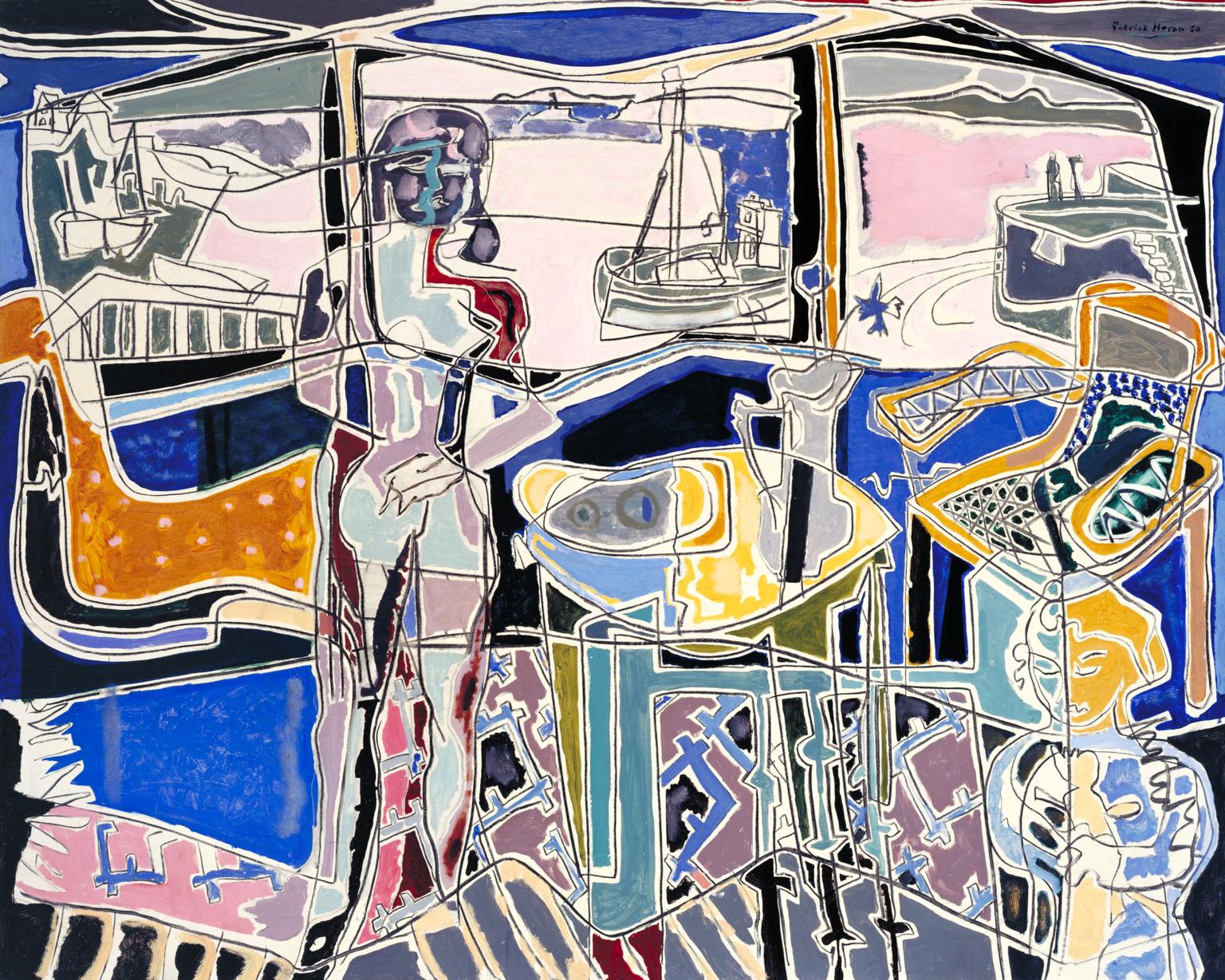
Patrick Heron, Harbour Window with Two Figures : St Ives : July 1950 1950
13/30
artworks in Modern Conversations
Stephen Partridge, Monitor 1974
Monitor is one of the early defining works of video art in Britain, revealing the structural possibilities the medium offered to artists. For Partridge it is a pure exploration of its working process. A 1973 Sony monitor is recorded close up by a camera, the hardware becoming the subject of the video. Thecamera, linked to the monitor it is filming, creates in the monitor an infinite succession of repeated images of itself. The artist’s hands are seen to turn the monitor to the right through 90 degrees, challenging the physical restrictions of the monitor by becoming physically involved with repositioning it.
Gallery label, September 2016
14/30
artworks in Modern Conversations
Karl Weschke, Pillar of Smoke 1964
Weschke arrived in Britain as a German prisoner of war and went on to spend forty years living in Cornwall. This painting, based on the burning of the gorse on the moorland above the town of Zennor, shows smoke rising in a threatening, anthropomorphic mass. Painted at the height of the Vietnam War, it evokes the barbarism suffered by successive generations. Weschke drew on his own memories of the Second World War, when the landscape would smoke for days after battle, while his image also suggests the bombing of Dresden and the burning of bodies in the death camps.
Gallery label, March 2024
15/30
artworks in Modern Conversations
Margaret Mellis, Sobranie Collage 1942
16/30
artworks in Modern Conversations
Peter Lanyon, White Track 1939–40
17/30
artworks in Modern Conversations
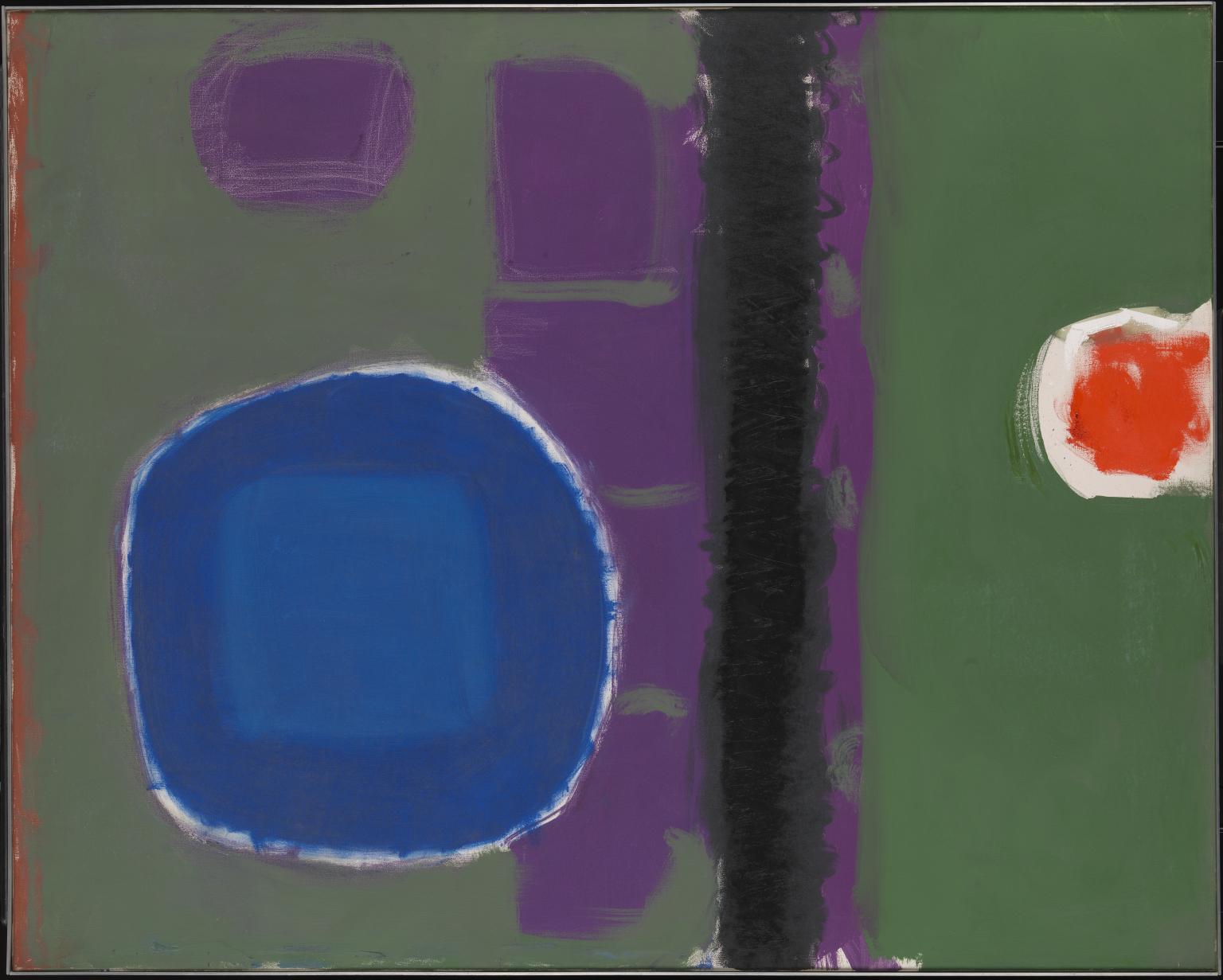
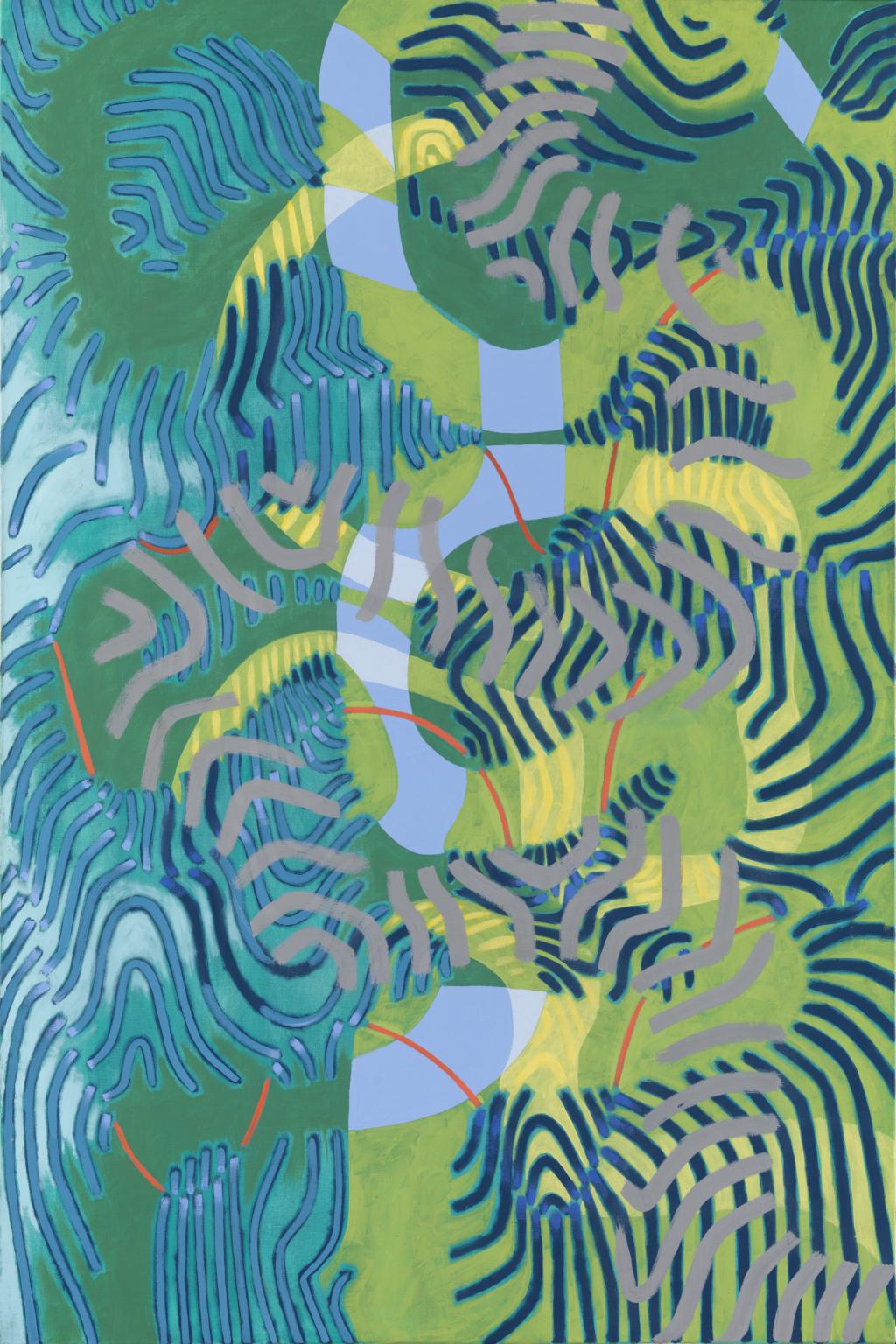
Bryan Wynter, Green Confluence 1974
18/30
artworks in Modern Conversations
Sir Terry Frost, Winter 1956, Yorkshire 1956
Frost's move from St Ives to Leeds in Yorkshire introduced him to a new landscape. In the Yorkshire Dales he felt like a tiny presence in a huge expanse of space.
He related this unusually long, thin work to a particular experience: tobogganing with friends down a steep hill in Leeds, quite out of control. He said the black form at the top left derived from a Russian hat worn by his friend; the long sweep of the lines evokes his experience of careering down the hill.
Gallery label, September 2004
19/30
artworks in Modern Conversations
Alfred Wallis, P.Z. 11 c.1928
Alfred Wallis was a seaman, ice cream seller and rag-and-bone man before he took up painting in old age. He said he painted ‘what used to be’ and many of his works depict a remembered past.In 1928 he met professional artists Ben Nicholson and Christopher Wood, for whom Wallis’s work represented an instinctive and naïve folk art. As such, Wallis seemed to belong to the tradition of rustic characters common in literature, and represented a link to an apparently timeless English culture.
Gallery label, July 2007
20/30
artworks in Modern Conversations
John Wells, Relief Construction 1941
21/30
artworks in Modern Conversations
Roger Hilton, Oi Yoi Yoi 1963
In the early 1960s, Hilton’s art could be figurative or abstract but it always had an erotic charge. This is, perhaps, the most literal description of a situation in his art of that time. He once stated that ‘there are situations, states of mind, moods, etc., which call for some artistic expression’. He gave the source of the painting - ‘my wife dancing on a verandah, we were having a quarrel. She was nude and angry at the time and she was dancing up and down shouting oi yoi yoi – but it is more universal than that.’
Gallery label, September 2016
22/30
artworks in Modern Conversations
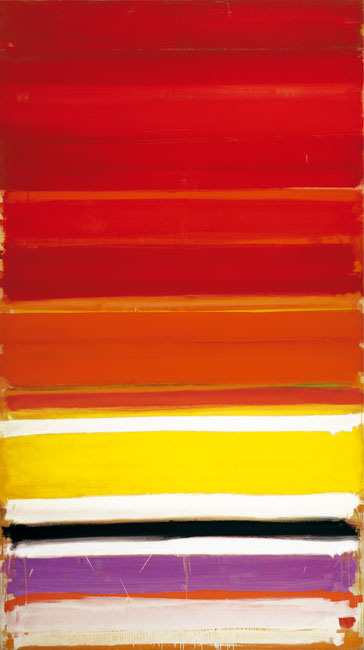
Patrick Heron, Horizontal Stripe Painting : November 1957 - January 1958 1957–8
Heron was a critic and painter who championed an approach to painting that assessed quality according to such formal values as the flatness of a composition and colour. Of his stripe paintings he wrote, ‘The reason why the stripes sufficed ... was precisely that they were so very uncomplicated as shapes ... the emptier the general format was, the more exclusive the concentration upon the experiences of colour itself.’ Heron resisted the total abandoning of subject matter and even such works as this have been seen in relation to landscape, the horizontal bands and colours perhaps suggesting the horizon at sunset.
Gallery label, February 2010
23/30
artworks in Modern Conversations
Sir Terry Frost, Green, Black and White Movement 1951
24/30
artworks in Modern Conversations
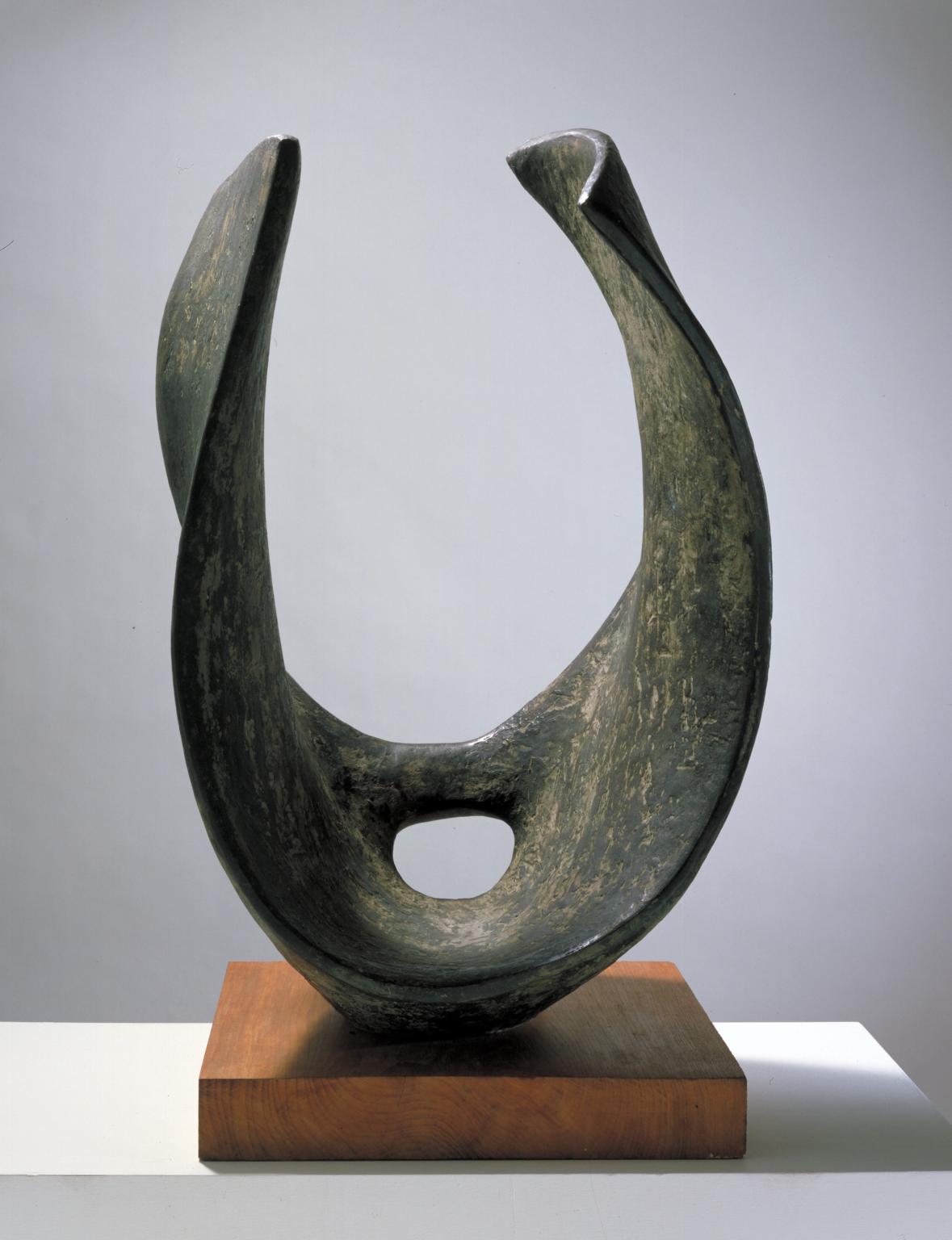
Dame Barbara Hepworth, Maquette, Three Forms in Echelon 1961
25/30
artworks in Modern Conversations
Denis Mitchell, Praze 1964
Denis Mitchell moved to Cornwall in 1930. He played an important role in the artistic development of St Ives following the Second World War. He was a founder member of the Penwith Society and was an assistant to Barbara Hepworth from 1949-59, working on many of her sculptures. In 1959 he began to make abstract sculptures in bronze using a local sand-casting foundry. Simple shapes can be cast by this method and the casts were initially rough, enabling him to use his manual skills to perfect and purify the surfaces. 'Praze' is a fine example of his streamlined single sculptural forms. It is a variation on a theme that he had begun to develop some years earlier. The title, 'Praze' is a Cornish place name.
Gallery label, August 2004
26/30
artworks in Modern Conversations
Jesus Rafael Soto, Horizontal Movement 1963
As the spectator passes this work, an optical effect causes the background of black and white lines to vibrate and flicker. Soto described Horizontal Movement as ‘one of the first truly mobile works that I had made’, referring to the addition of an iron rod that hangs in front of the lines. As in all his works the background lines are drawn by hand.
Gallery label, September 2004
27/30
artworks in Modern Conversations
William Scott, White, Sand and Ochre 1960–1
Shortly after he completed this painting, the artist said he hesitated to comment on it, beyond relating it to his other paintings from the same time. He did say, however, that a source of inspiration may have been his strong liking for Egyptian painted art. Although Scott had not visited Egypt at the time, he described a number of his paintings as having Egyptian references and titled some of them accordingly. While this work is obviously related to the earlier 'Ochre Still Life', also on view in this gallery, its shapes are even more flattened out and abstract and the surface texture resembles a plastered wall.
Gallery label, September 2004
28/30
artworks in Modern Conversations
Victor Pasmore, Abstract in White, Black, Indian and Lilac 1957
Pasmore believed that art derived from nature, and specifically from its underlying processes and structures rather than its surface appearance. In his reliefs Pasmore brought ideas of growth and abstract harmony into three dimensions. He rejected tilted elements because they were not organic developments of the rectangles in the way that horizontals and verticals are. He added: Geometry, though subject to the quoi of personal judgment, is a guide to the organic process.
Gallery label, August 2004
29/30
artworks in Modern Conversations
Alfred Wallis, Schooner under the Moon ?c.1935–6
30/30
artworks in Modern Conversations
Art in this room
Sorry, no image available
You've viewed 6/30 artworks
You've viewed 30/30 artworks