

Sir Joshua Reynolds, Three Ladies Adorning a Term of Hymen 1773. Tate.
16 rooms in Historic and Early Modern British Art
The first public exhibitions bring new audiences and new status to British art. This gallery recreates the spectacle of these early displays
The first temporary exhibition of contemporary art opens in London in 1760. Many more soon follow, notably the annual summer exhibitions held from 1769 by the new Royal Academy. For the thousands of visitors attending, these exhibitions can be overwhelming, unruly experiences. Noisy, hot and overcrowded, people come for the spectacle as much as for the art. They are as bursting with paintings as with people. As in this room, the pictures are densely hung from floor to ceiling in a kaleidoscope of styles and subjects.
For artists, this brings new challenges and opportunities. They worry that their work cannot be seen properly in the crowded conditions. To stand out against the competition, they bring ever greater individuality, experimentation and even flamboyance to their work. Art becomes regularly talked about in the newspapers, and reviews from critics can make or break careers.
Exhibitions become fashionable events. Artists are able to directly address more people than ever before, beyond a small number of elite patrons. To engage this wider public, their work often reflects popular interests and current affairs. Exhibitions become places where the nation’s ideas and anxieties are expressed.
There is a new buzz around British art. A sense of national identity is projected through these exhibitions. They help define a ‘British school’, which is celebrated as a sign of the nation’s cultural wealth and progress. Exhibitions contribute to how the country imagines itself on the world stage.
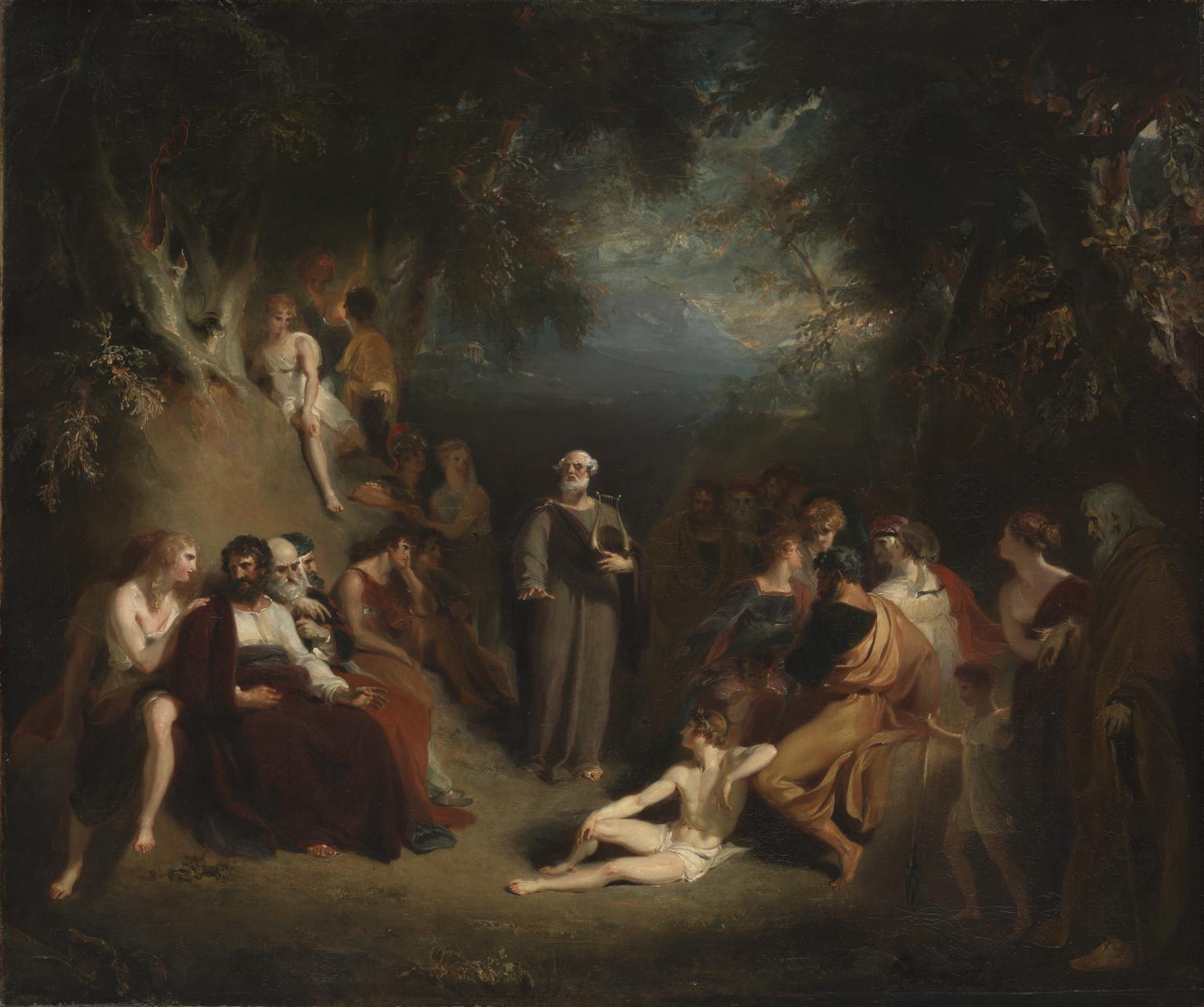
Sir Thomas Lawrence, Homer Reciting his Poems 1790
For most of his career, Lawrence featured in the Royal Academy exhibitions as a portrait painter. He became President of the Academy and, like his predecessor Joshua Reynolds, aspired to be a history painter. This early work was exhibited in 1791. It was painted for the connoisseur, Richard Payne Knight, and its subject and style were calculated to suit his classical taste. In a woodland glade, the Greek poet Homer is shown reciting his Iliad to an admiring audience. The nude youth in the foreground was drawn from a famous pugilist (professional boxer) named Jackson.
Gallery label, February 2016
1/30
artworks in The Exhibition Age
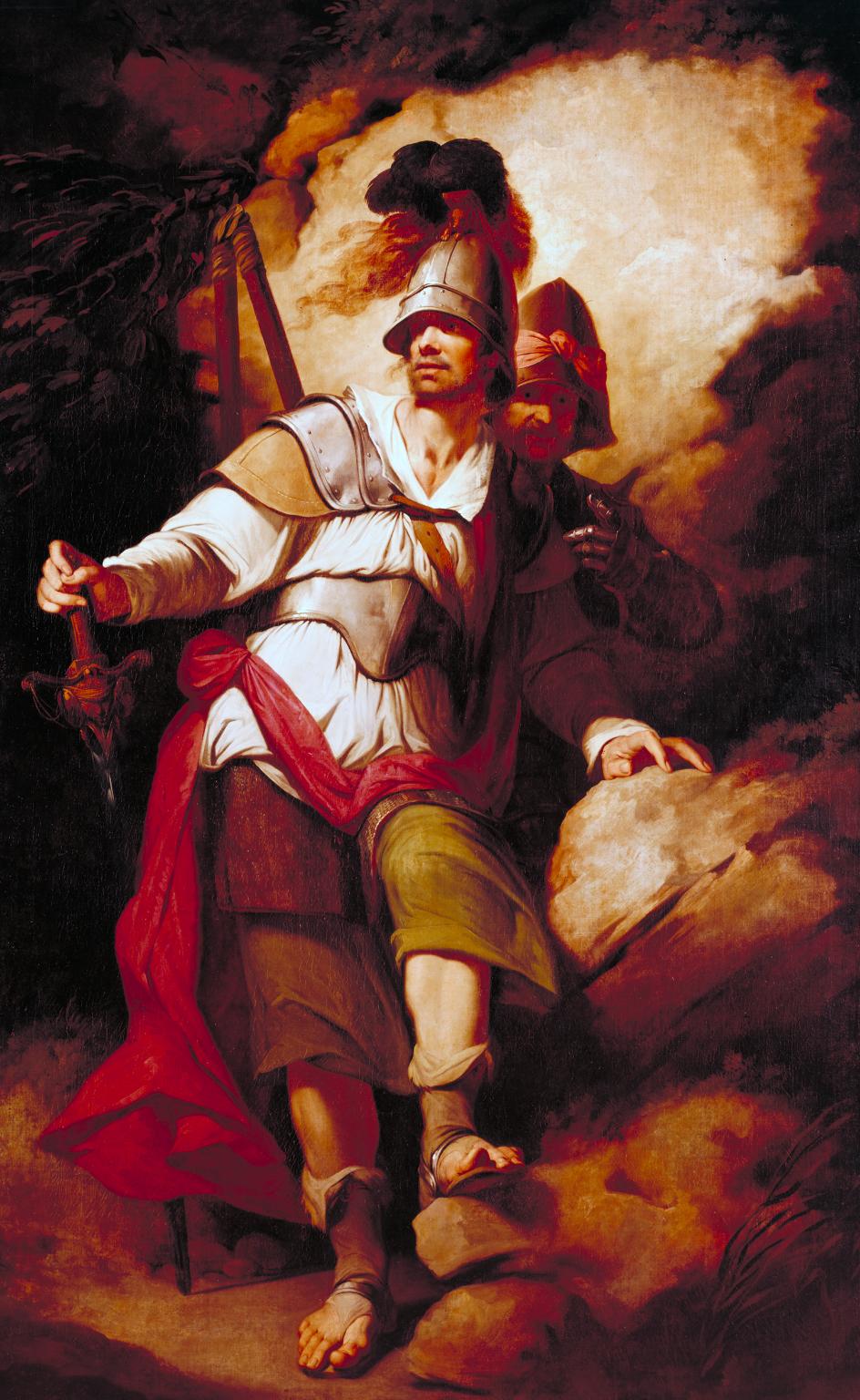
John Hamilton Mortimer, Sir Arthegal, the Knight of Justice, with Talus, the Iron Man (from Spenser’s ‘Faerie Queene’) exhibited 1778
This painting refers to the courtly fantasy of British origins prevalent in the Elizabethan age and the seventeenth century. It illustrates Edmund Spenser’s The Fairie Queene 1590/6, a poem that claims Elizabeth I as heir to King Arthur’s British kingdom.
Arthegal was one of the Queene’s knights, trained by the immortal Astraea to be the champion of True Justice. She gave him the invincible sword, Chrysaor, which he holds here. Behind him is Talus, his squire. Talus was a man ‘made of iron mould, immoveable, resistlesse’. He carries an iron flail with which he threshes out falsehood.
Gallery label, September 2004
2/30
artworks in The Exhibition Age
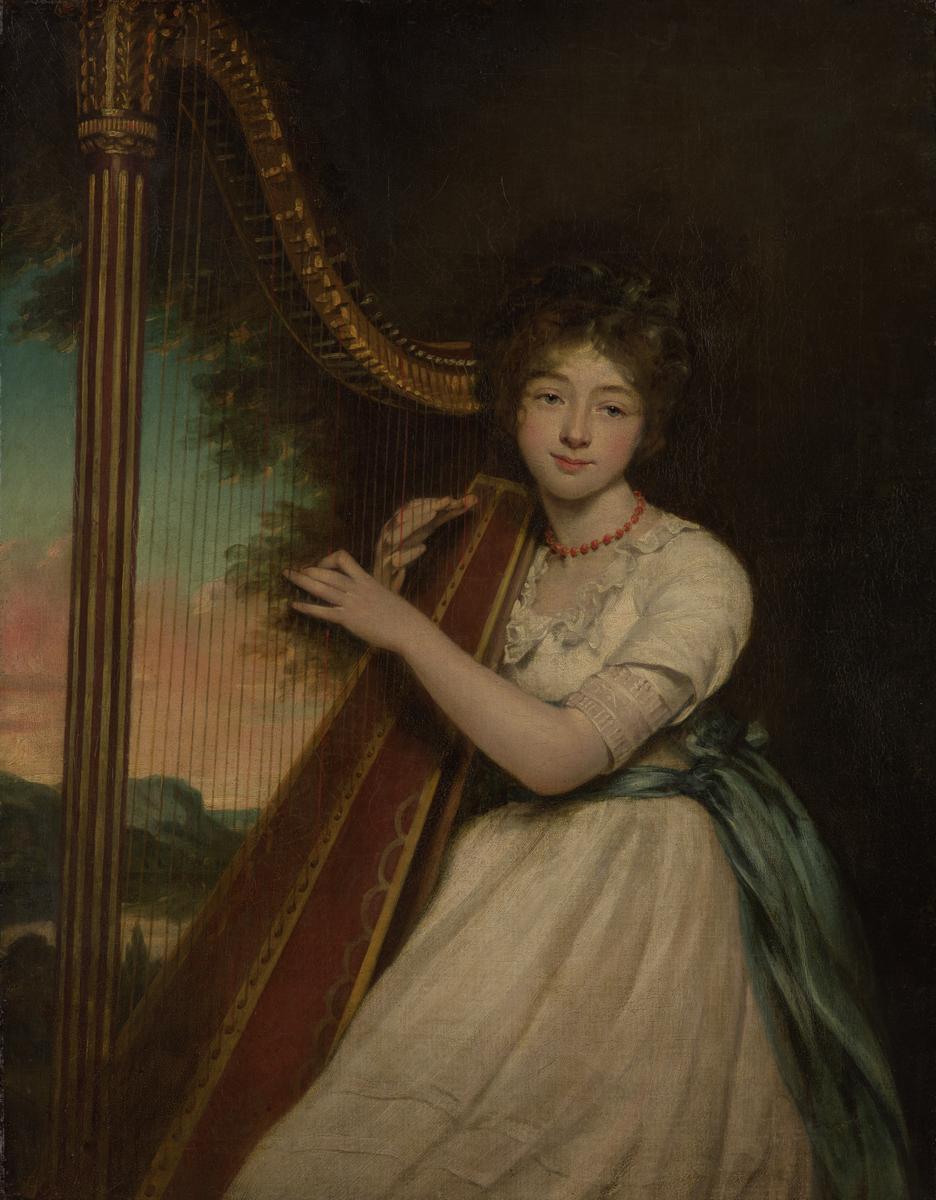
James Northcote, A Young Lady Playing the Harp ?exhibited 1814
A Young Lady Playing the Harp ?exhibited 1814 is an oil painting by the English artist and author James Northcote. It depicts a young harpist wearing a white dress tied with a long green sash, with a string of red beads around her neck. The harpist gazes forward, both hands raised to pluck the strings. She is seated against a rural backdrop dominated by a large, dark tree on the right, which frames her compositionally. The backdrop on the left, seen through the strings of the harp, features a twilit sky over hills and a lake.
3/30
artworks in The Exhibition Age
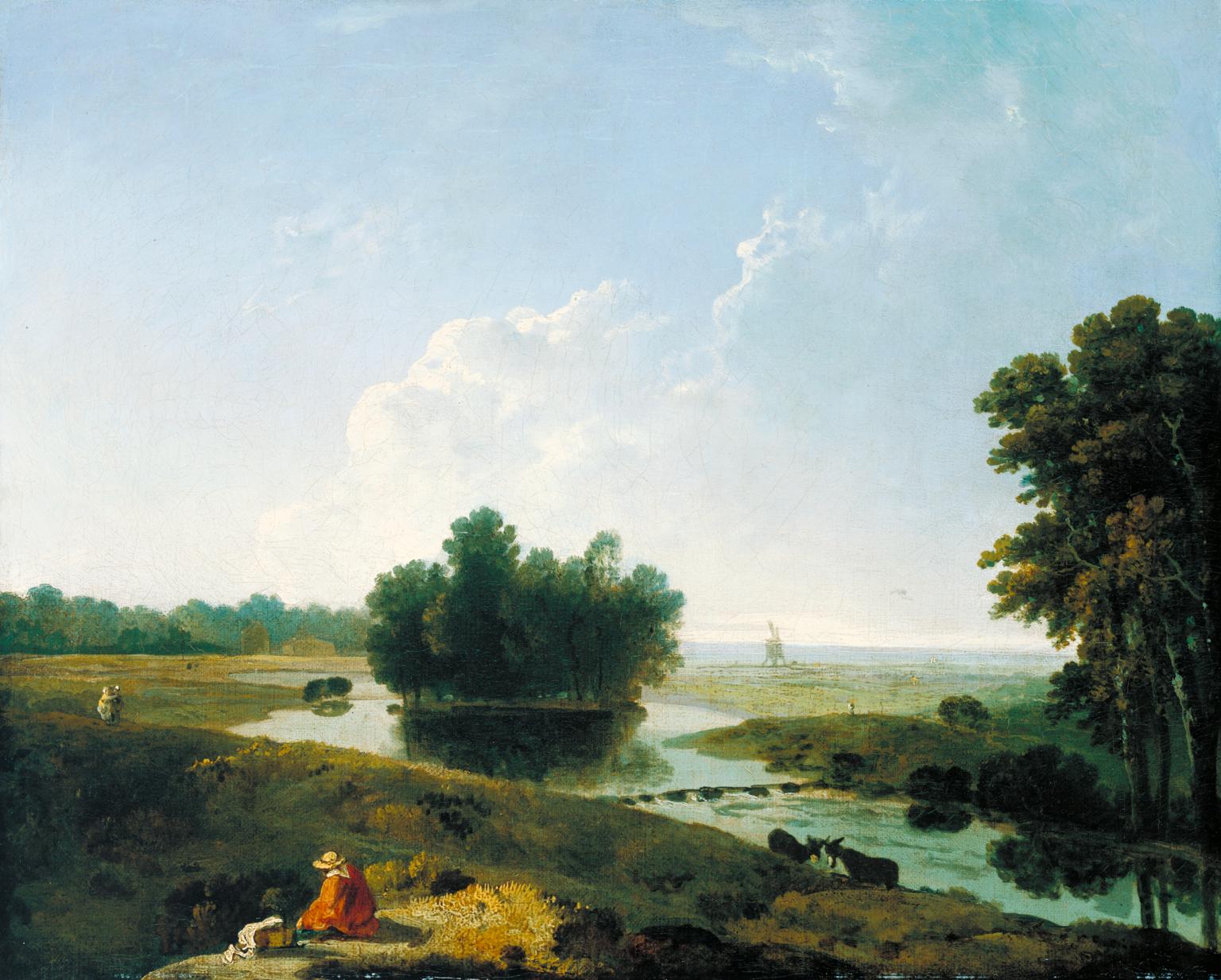
Richard Wilson, On Hounslow Heath ?exhibited 1770
The view shows the watermeadows beside the River Crane. This area of Hounslow Heath was not known for its beauty or cultural significance. Instead, the attraction of this picture lies in the beauty of the sky and the reflections in the water. In this it is an example of a new type of landscape view, designed to bring a vision of a rural idyll into the city dweller's home. The picture was commissioned by Tom Davies, who was a Bloomsbury bookseller, and one of a growing number of middle-class urban patrons of English landscape subjects.
Gallery label, September 2004
4/30
artworks in The Exhibition Age
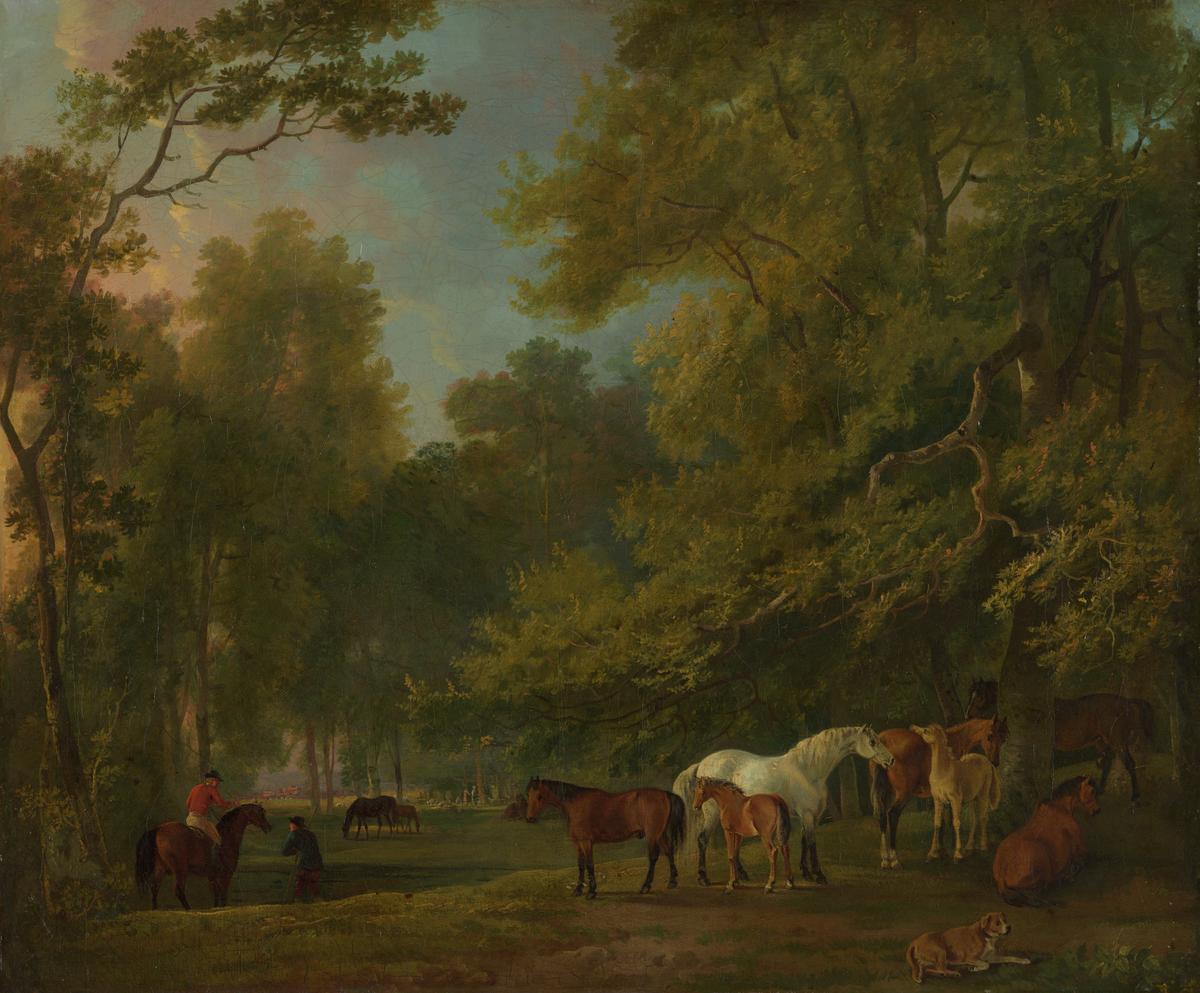
Sawrey Gilpin, George Barret Senior, Broodmares and Colts in a Landscape ?exhibited 1783
This painting was a collaboration between the artists Sawrey Gilpin and George Barret, who painted the horses and landscape respectively. Gilpin was a skilled painter of horses but lacked confidence in painting landscapes. He often invited other artists to add landscape backgrounds to his pictures. This was not an unusual practice for artists as it made the most of their specialisms. Barret and Gilpin collaborated on several occasions. This raised the ambition and quality of Gilpin’s artworks, increasing their status at exhibitions or sales. This painting is thought to have been exhibited at the Society of Artists in 1783.
Gallery label, October 2023
5/30
artworks in The Exhibition Age
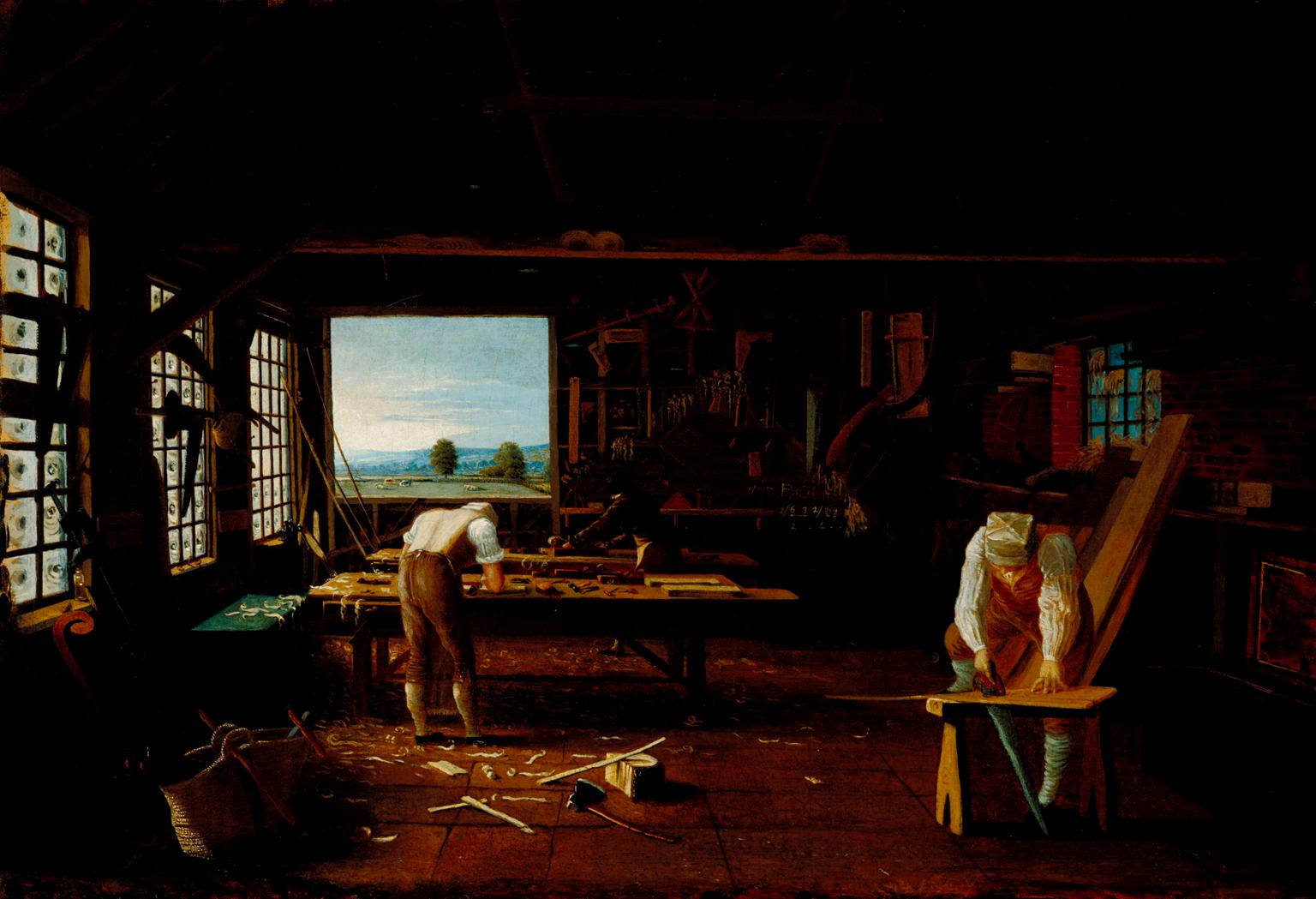
John Hill, Interior of the Carpenter’s Shop at Forty Hill, Enfield ?exhibited 1813
John Hill shows the interior of a small joinery shop that likely belonged to him and his father Thomas. Various tools and stages of production are visible: an axe and saw for cutting the wood in the foreground, and a planer for shaping it in the background. The unglazed window in the far corner of the workshop is large enough for big pieces of wood to pass through. It also provides ventilation and light for the ‘master’ carpenter. He is distinguished from his assistants by his moleskin hat and dark jacket. John likely included himself in the picture, possibly as this master carpenter (although this figure might also be his father). John later described himself as an ‘entirely self-taught' painter. He exhibited this painting at the Royal Academy in 1813. Such representations of craftsmen at work are rare in British art of this period.
Gallery label, October 2023
6/30
artworks in The Exhibition Age
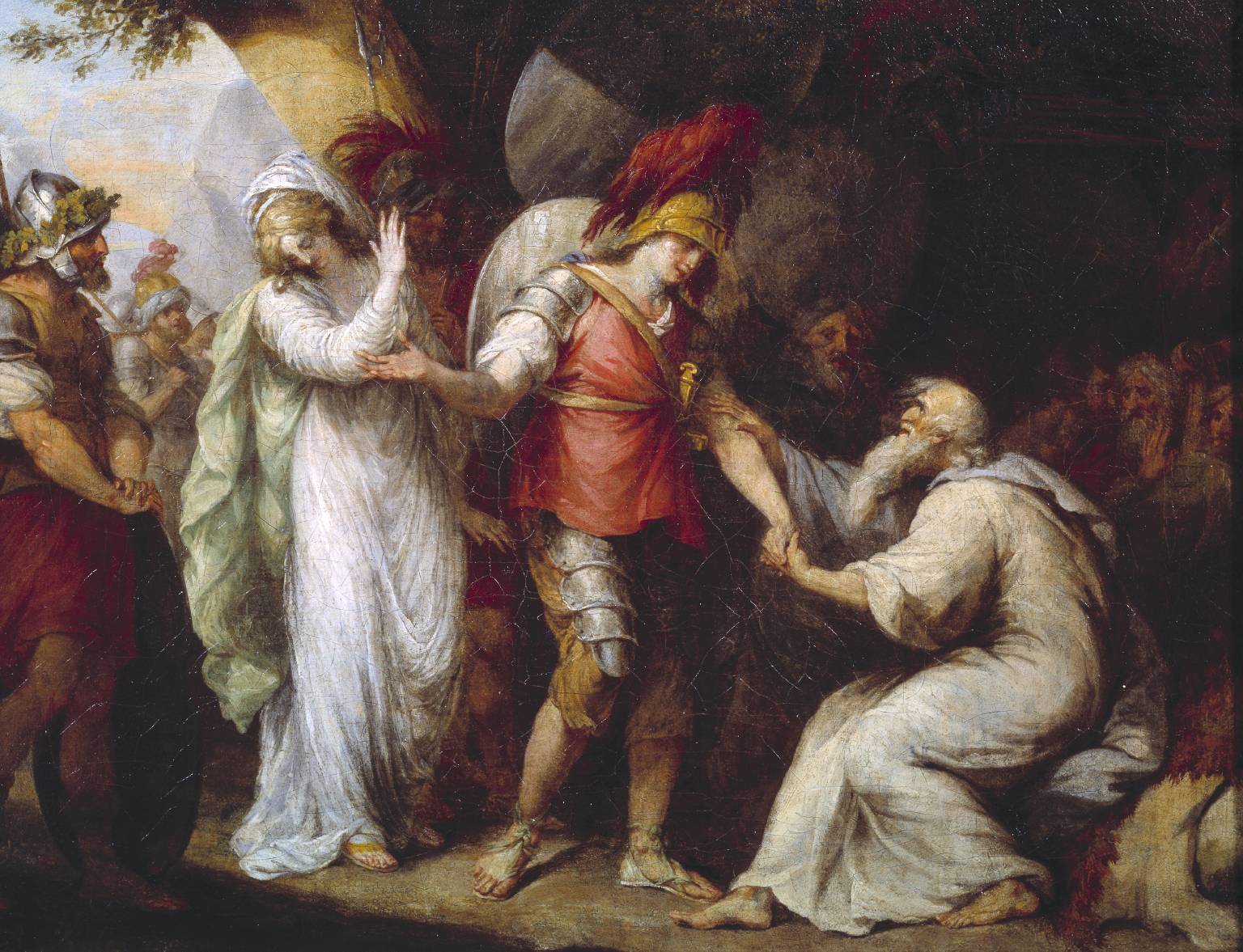
Charles Reuben Ryley, Oscar Bringing Back Annir’s Daughter 1785
Scotland’s legendary past, as told by the ancient Gaelic bard, Ossian, inspired this painting. It shows the famed warrior Oscar (in red), returning triumphant from battle to Annir, the elderly King of Inis-Thona. Oscar's victory reunites the king with his daughter. Ossian’s epic poem was published in 1765 and inspired many artists and writers. Nearly 60 Ossian subjects were exhibited in London between 1771-1830, including five pictures by Charles Reuben Ryley. However, the authenticity of the poem was soon questioned. The publisher, James Macpherson, had, in fact, invented the saga by blending Gaelic mythology with other sources and his own writing.
Gallery label, February 2024
7/30
artworks in The Exhibition Age
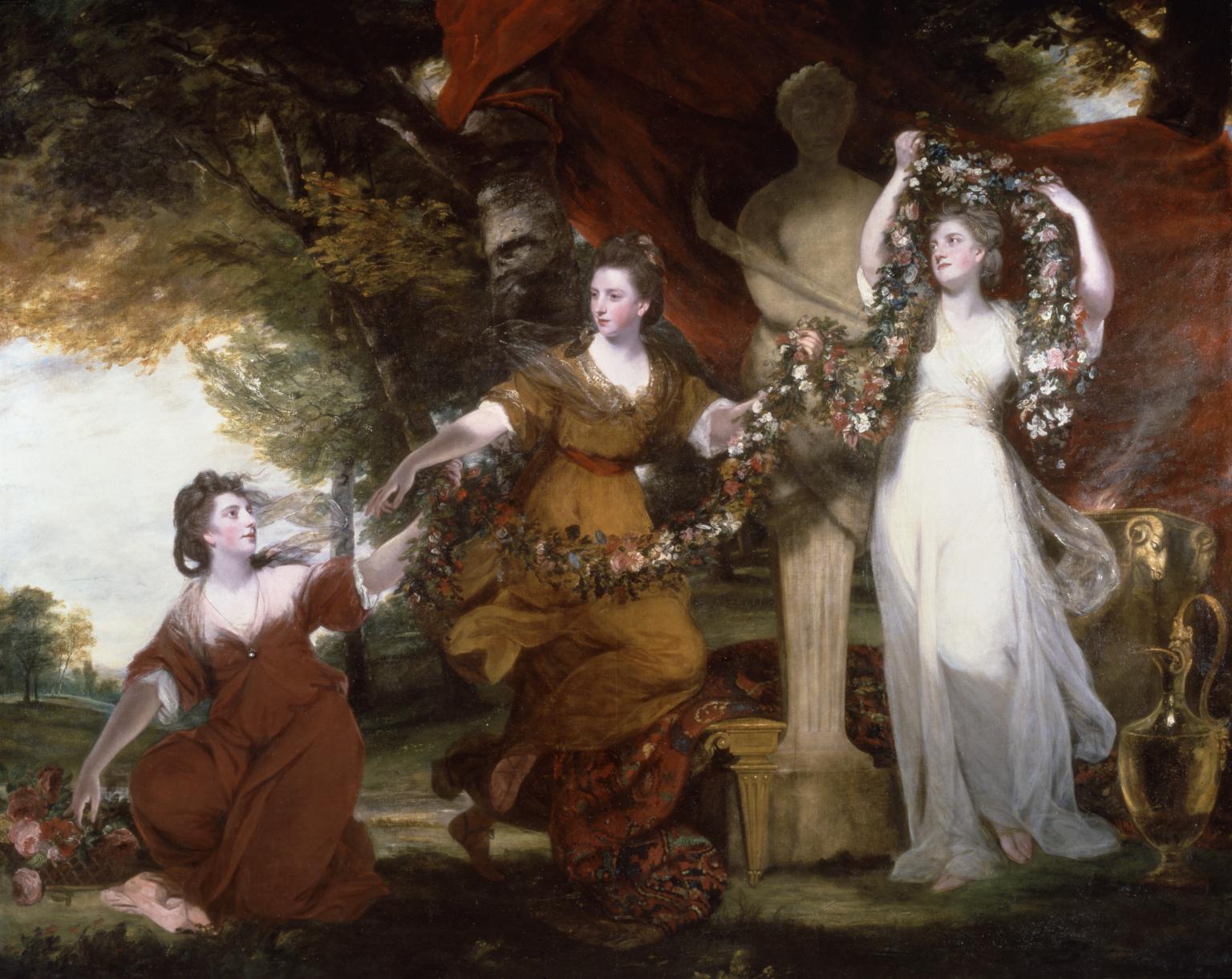
Sir Joshua Reynolds, Three Ladies Adorning a Term of Hymen 1773
Joshua Reynolds paints the aristocratic Montgomery sisters, Barbara, Elizabeth and Anne, decorating a classical sculpture with flowers. Their poses associate them with the mythological Graces, personifying charm, grace and beauty. This emphasises the sisters’ beauty and elegance and may also playfully allude to their fame as ‘The Irish Graces’. By including the statue of Hymen, the Greek god of marriage and fertility, Reynolds also celebrates their desirability for marriage. Reynolds exhibited this painting in 1774. It exemplifies his ‘grand style’ of portraiture, which drew inspiration from classical and Renaissance art, and favoured idealised elements rather than current or specific fashions. The painting prompted one art critic to praise Reynolds’ ‘great Richness of Imagination’.
Gallery label, February 2024
8/30
artworks in The Exhibition Age
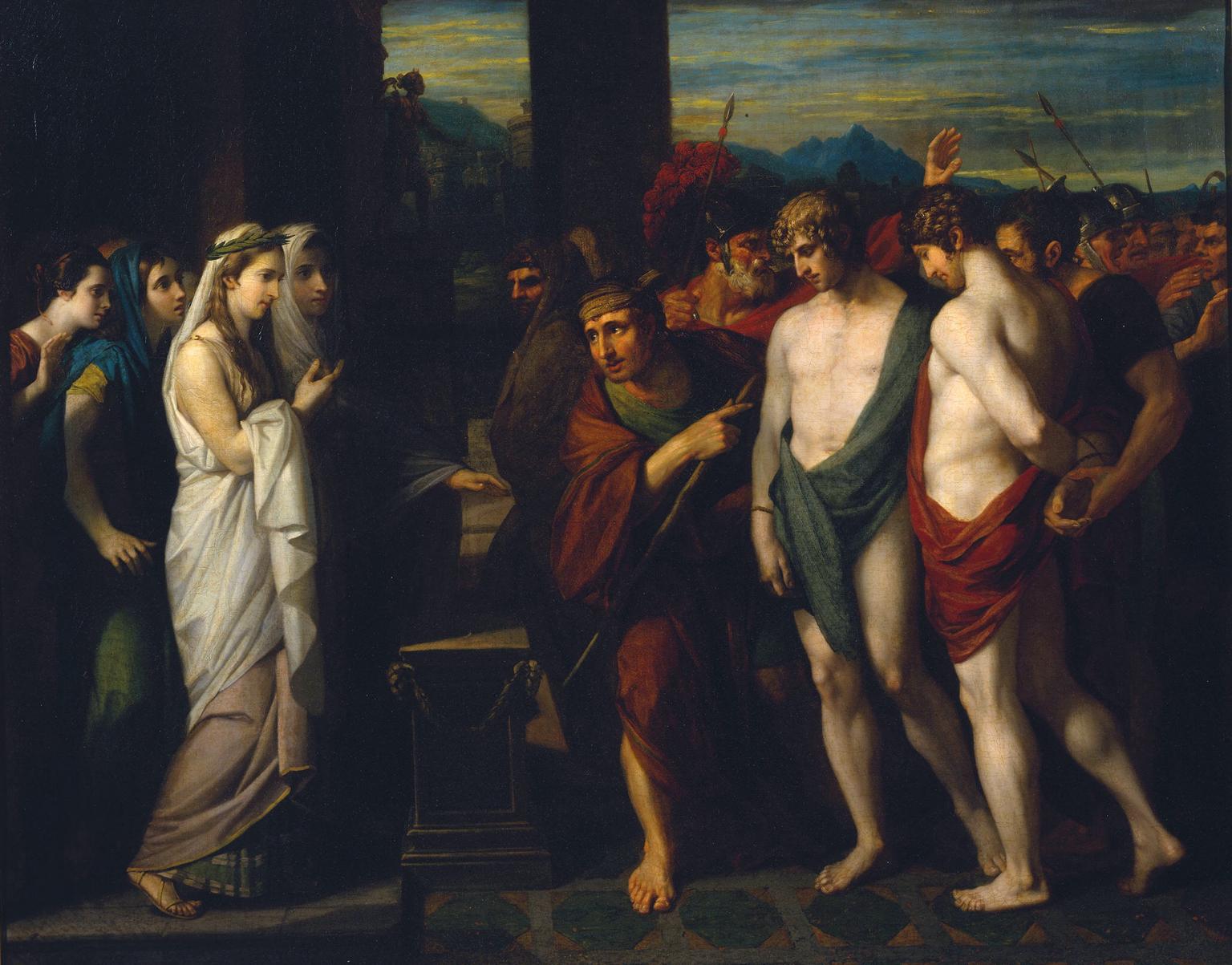
Benjamin West, Pylades and Orestes Brought as Victims before Iphigenia 1766
This painting’s story is based on a play by the classical author Euripides. The two semi-naked men have been arrested for trying to steal a gold statue of the goddess Diana from the temple. They have been brought before Iphigenia, a priestess of Diana, to be sacrificed on the altar. But here Iphigenia recognises the man in the red drapery as her long-lost brother, Orestes. The composition of this picture was heavily influenced by the artist’s studies in Italy. He particularly admired the sculptural friezes on classical tombs and the Renaissance frescoes of Raphael.
Gallery label, February 2016
9/30
artworks in The Exhibition Age
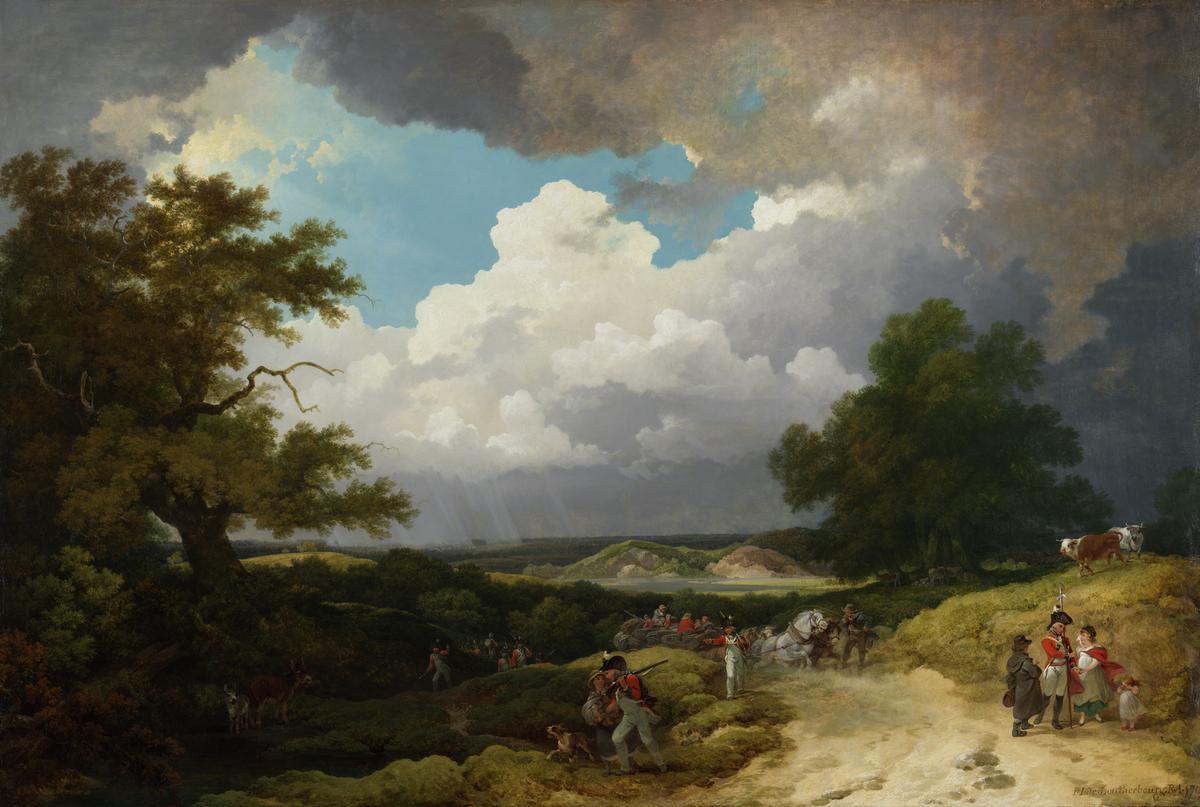
Philip James De Loutherbourg, A Distant Hail-Storm Coming On, and the March of Soldiers with their Baggage 1799
As the war against France continued during the 1790s, Philip James de Loutherbourg increasingly turned his attention to military and naval subjects. Rather than depicting a grand battle, here he emphasises the domestic impact of war. British soldiers march through the countryside, leaving tearful families behind. The dark clouds and stormy weather only increase the sombre, foreboding mood. When this painting was exhibited in 1799, one reviewer commented on its appeal to the viewer’s emotions, praising the ‘variety of beauties which cannot be easily described, but are felt by the connoisseur on the first view.’
Gallery label, February 2024
10/30
artworks in The Exhibition Age
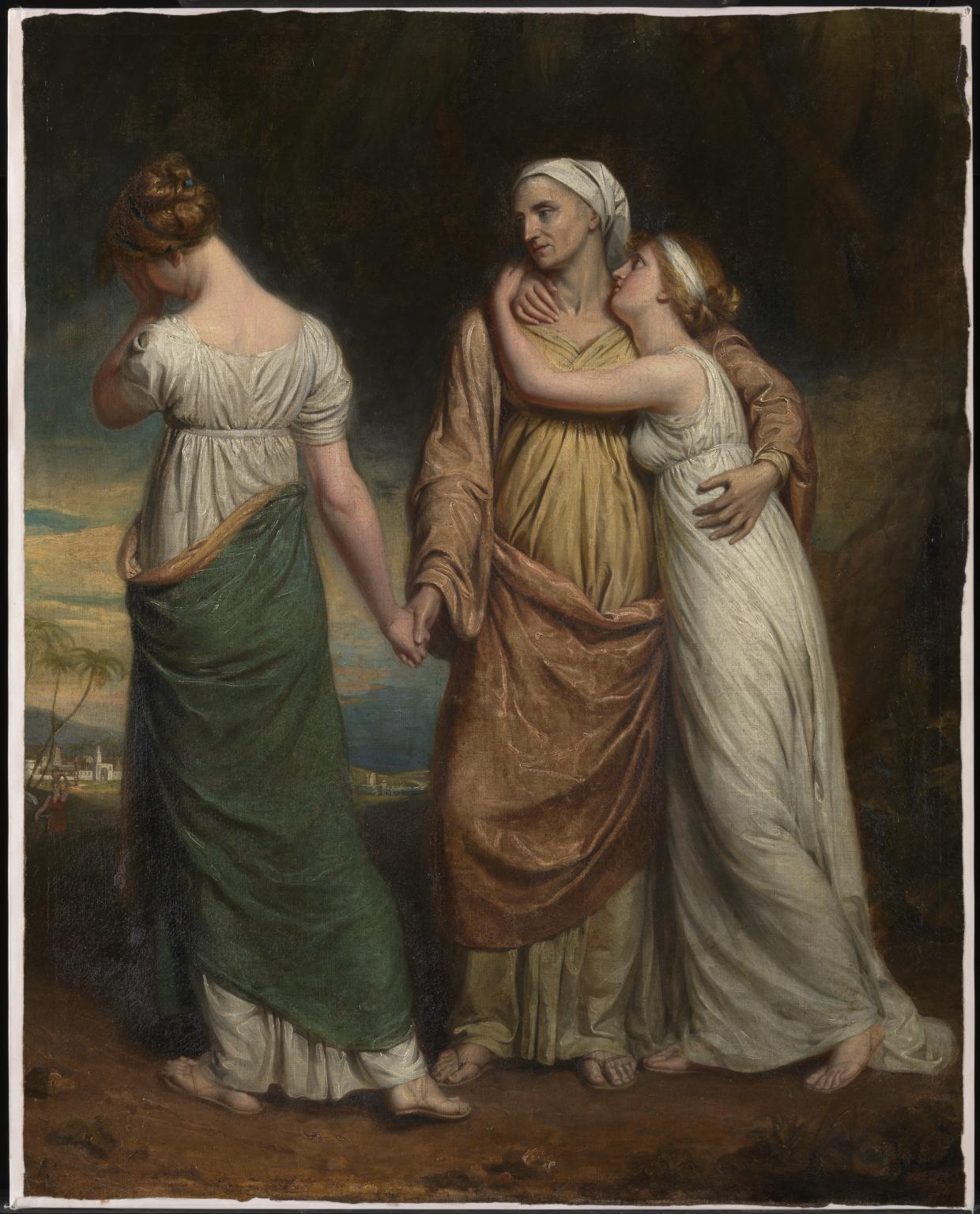
George Dawe, Naomi and her Daughters exhibited 1804
This scene is from the Old Testament: Naomi, in the centre, encourages her two widowed daughters-in-law to return to their people rather than accompany her to Bethlehem. George Dawe shows the moment when Orpah (left) leaves weeping, but Ruth (right) clings to Naomi and refuses to go. This was the first painting Dawe exhibited at the Royal Academy. By demonstrating his ability to paint emotive and high-minded subjects, Dawe likely hoped the painting would help him stand out as a talented newcomer. The restrained colours, sculptural style and idealised figures were popular with painters at the time.
Gallery label, February 2024
11/30
artworks in The Exhibition Age
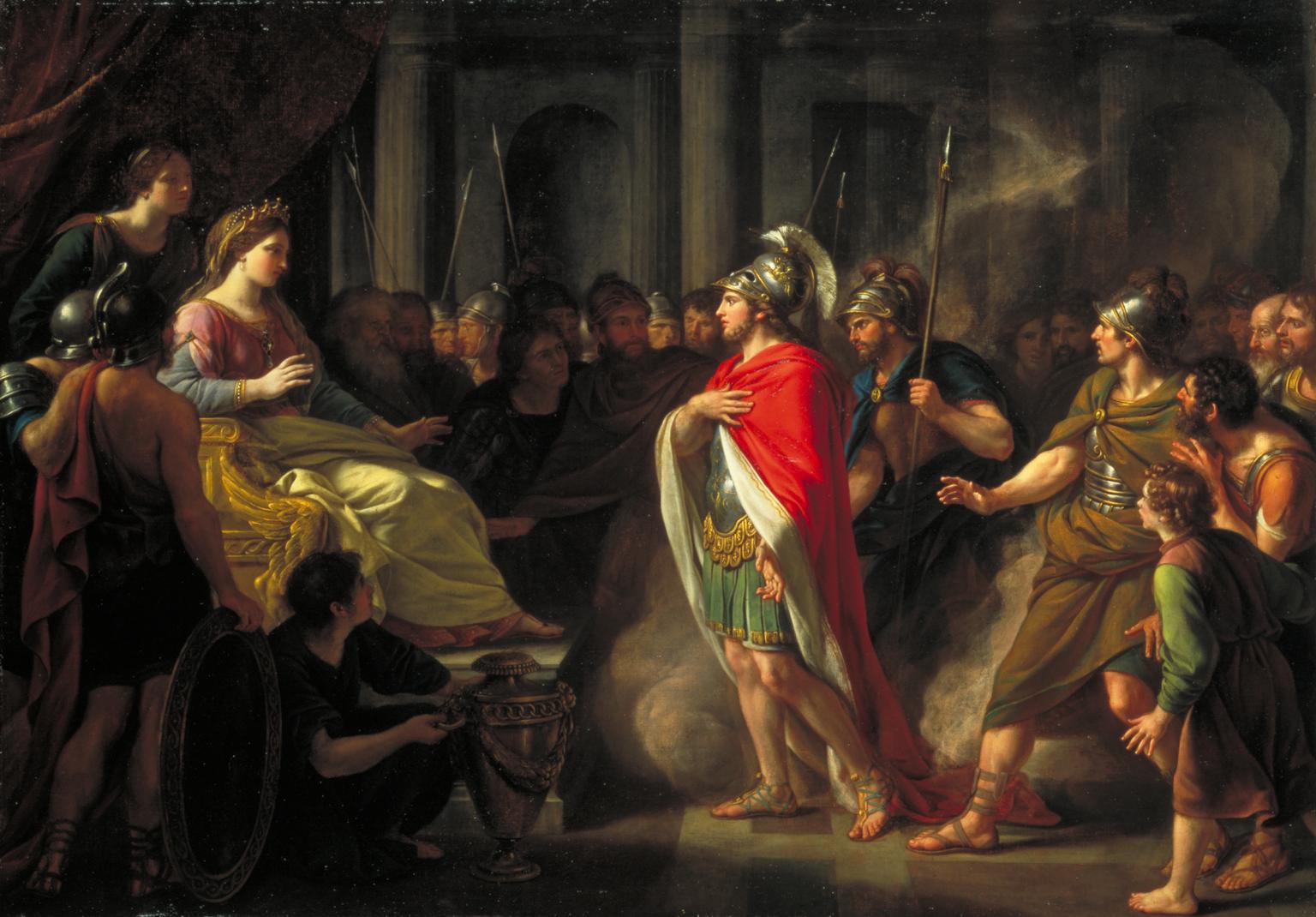
Sir Nathaniel Dance-Holland, The Meeting of Dido and Aeneas exhibited 1766
This picture shows the meeting of the Trojan prince Aeneas and the Carthaginian queen Dido, from Virgil’s epic poem, the Aeneid. Aeneas was shipwrecked near Carthage after the sack of Troy. The goddess Venus made Dido fall in love with him and helped him to hide in her citadel. He watches Dido welcome his fellow Trojans and when she asks to see their ‘king’ the mist clears and Aeneas reveals his identity. Dance-Holland made this picture while he was in Rome and sent it to London to be exhibited as a way to advertise his imminent return to Britain.
Gallery label, February 2016
12/30
artworks in The Exhibition Age
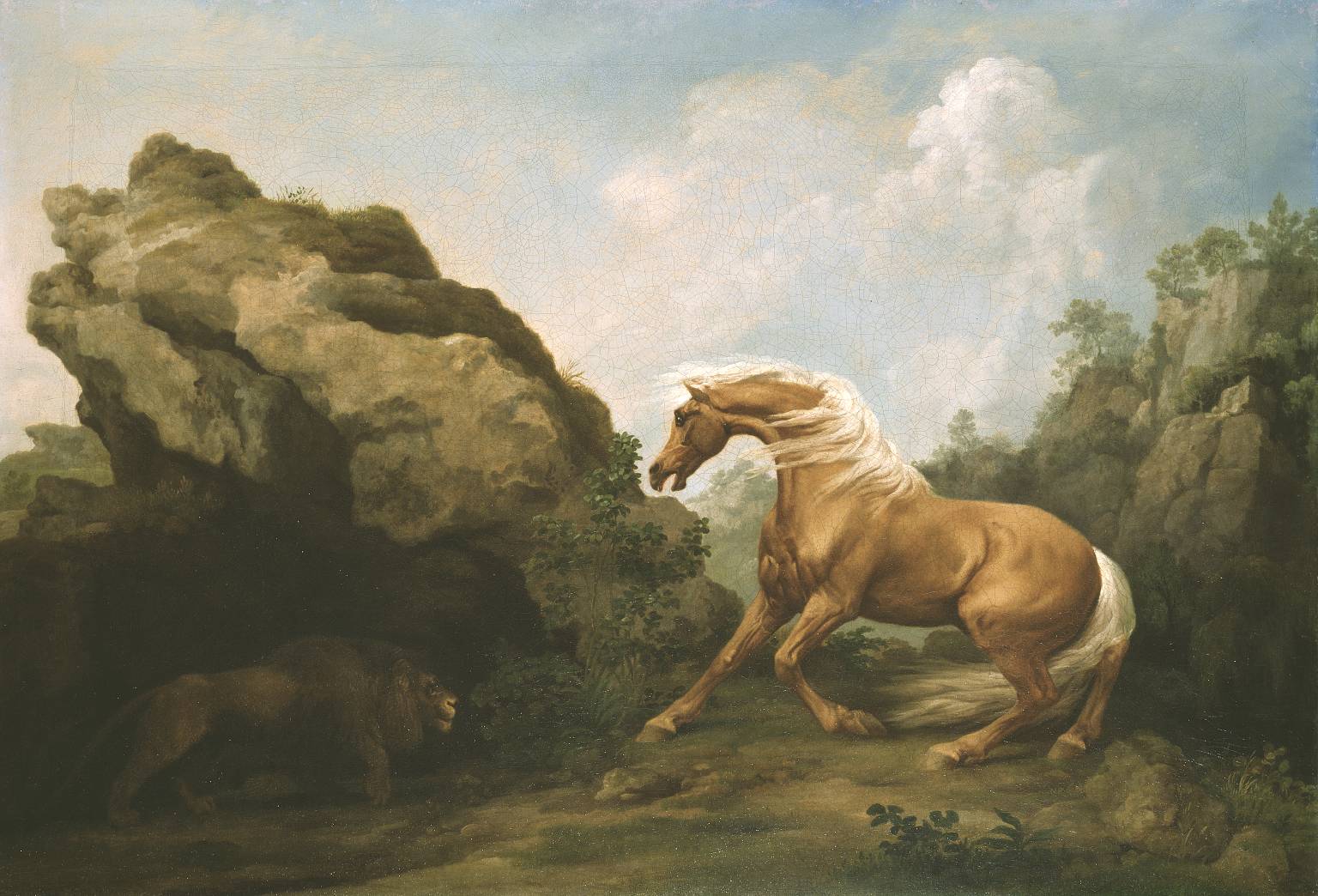
George Stubbs, Horse Frightened by a Lion ?exhibited 1763
The dramatic theme of a lion attacking a horse preoccupied Stubbs for over thirty years. This painting comes from a series of four episodes in a terrifying attack on a passive horse. This is the first stage, as the horse scents the lion emerging from its cave and rises up in fright. The setting for this violent encounter is the harsh, rocky landscape of Creswell Crags in the Peak District. The area was then an inaccessible, wild region that fascinated Stubbs. The scenery makes a suitably romantic background for the ‘sublime’ drama of the scene.
Gallery label, February 2016
13/30
artworks in The Exhibition Age
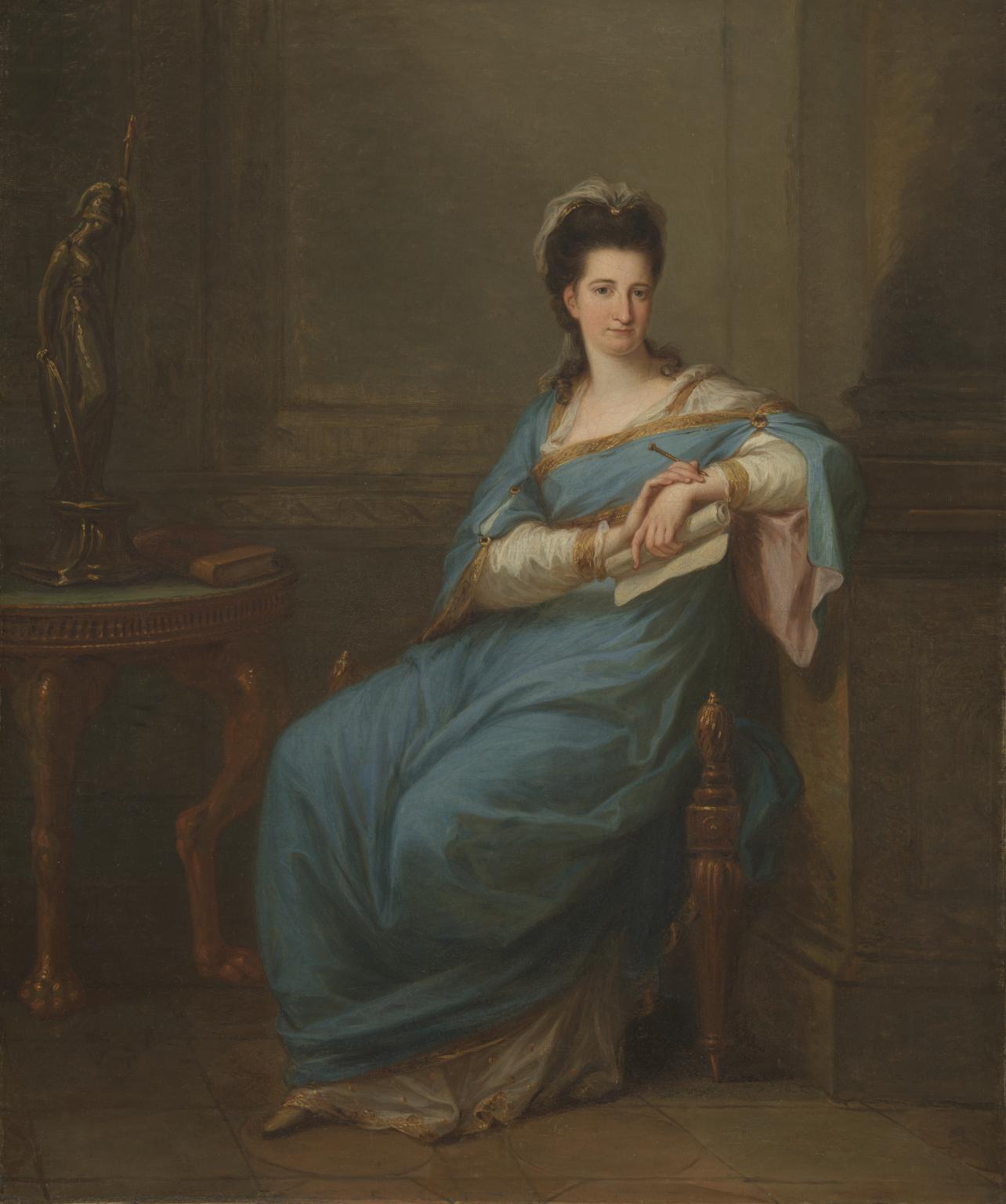
Angelica Kauffman, Portrait of a Lady c.1775
Angelica Kauffman was hugely successful – by the 1770s, her work was so popular that one contemporary quipped, ‘the whole World is Angelica-mad’. In portraits like this, Kauffman helped establish and promote an image of feminine creativity and intellect. While we do not know the sitter’s identity, the writing instruments she holds emphasise her learning, perhaps even signalling literary ambitions. The book and statue of Minerva (the Roman goddess of wisdom) on the table, further underline this. Dressed in classicising robes, she looks confidently out at the viewer. Such images also reflect the strong network of women – patrons, fellow artists, intellectuals, and professionals – that Kauffman relied upon throughout her career.
Gallery label, February 2024
15/30
artworks in The Exhibition Age
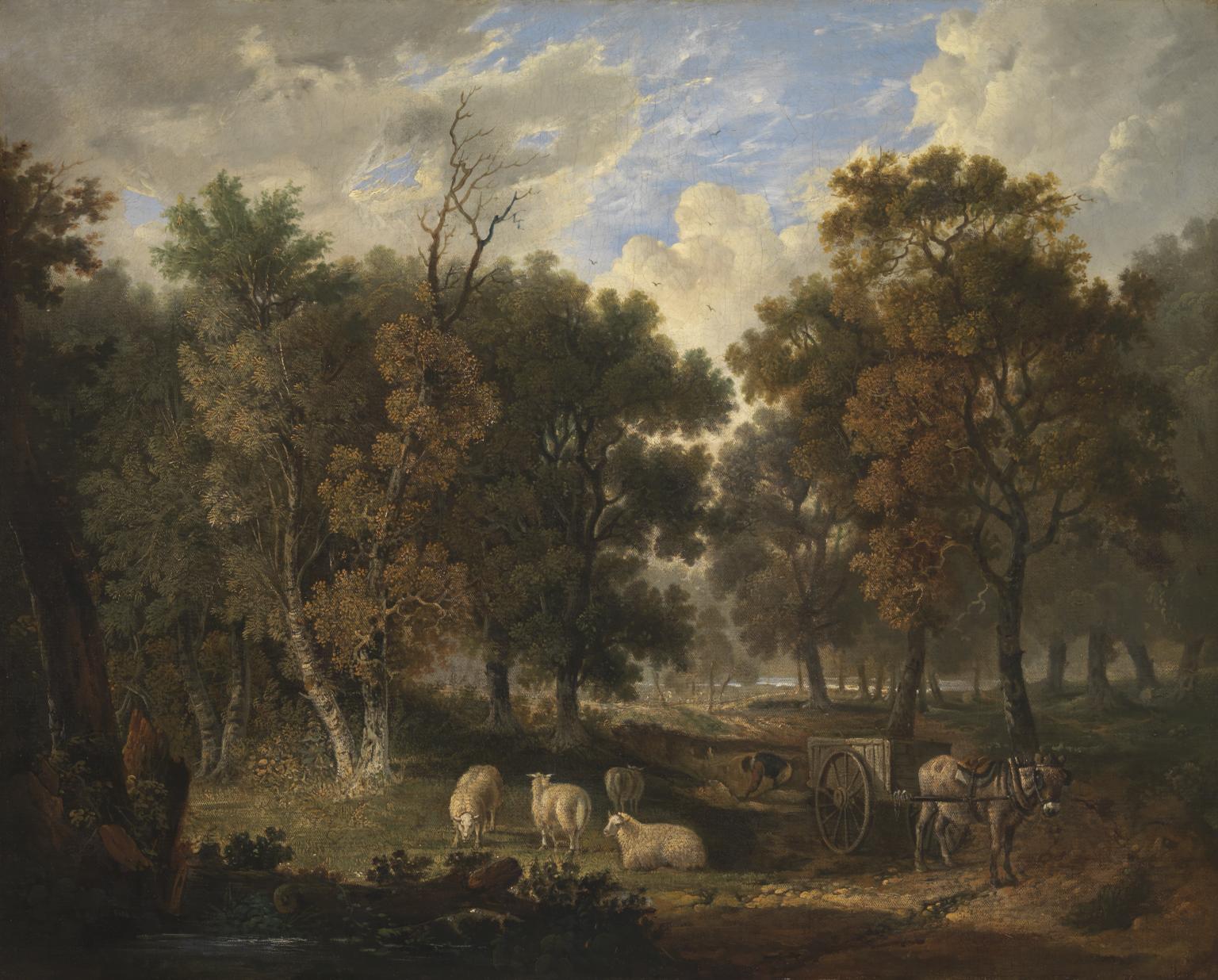
Robert Ladbrooke, Wood Scene exhibited 1806
16/30
artworks in The Exhibition Age
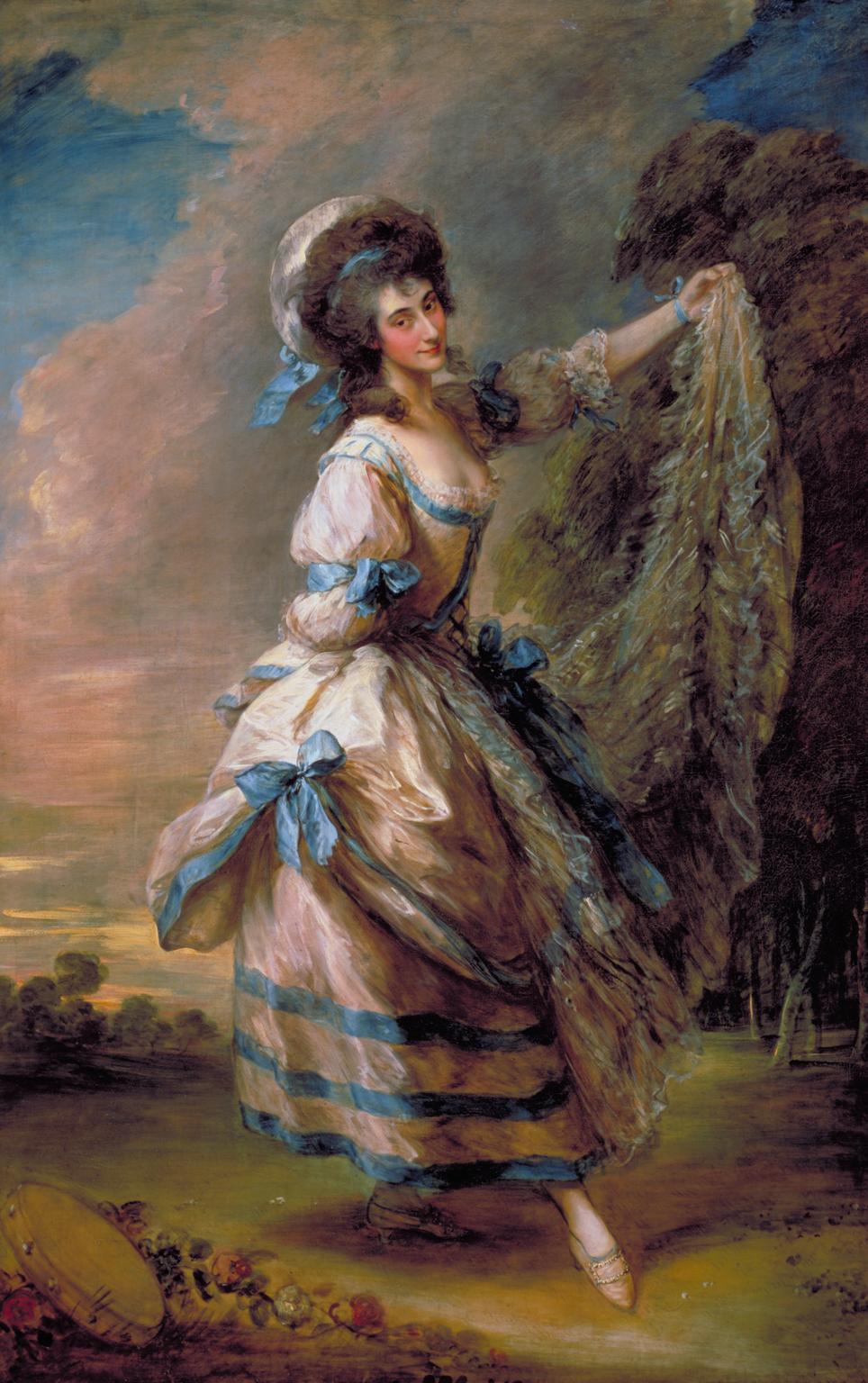
Thomas Gainsborough, Giovanna Baccelli exhibited 1782
This portrait shows the famous Italian dancer Giovanna Zanerini, known on the stage as Baccelli, at the height of her career. Her elaborate costume seems to be adapted from the ballet Les Amants Surpris in which she had recently taken London by storm. Baccelli was the mistress of John Sackville, 3rd Duke of Dorset who commissioned the painting. The rapid brushwork, translucent paint and shimmering light effects are typical of Gainsborough’s style at this time. When the portrait was first exhibited, it was chiefly praised as an excellent likeness; ‘as the Original, light airy and elegant’.
Gallery label, February 2016
17/30
artworks in The Exhibition Age

George Stubbs, Horse Devoured by a Lion ?exhibited 1763
This is one of at least 17 works Stubbs made of a lion stalking and attacking a horse. Here he depicts the moment the lion sinks its teeth into the terrified horse, set against the backdrop of Creswell Crags in the Peak District. The painting showcases Stubbs’s anatomical precision, informed by his studies of caged lions at the Tower of London. It also highlights his efforts to raise the status of animal painting by showing its emotional and narrative power. By depicting the dramatic climax of the encounter, Stubbs evokes the awe and terror felt when faced with untamed nature.
Gallery label, December 2020
18/30
artworks in The Exhibition Age
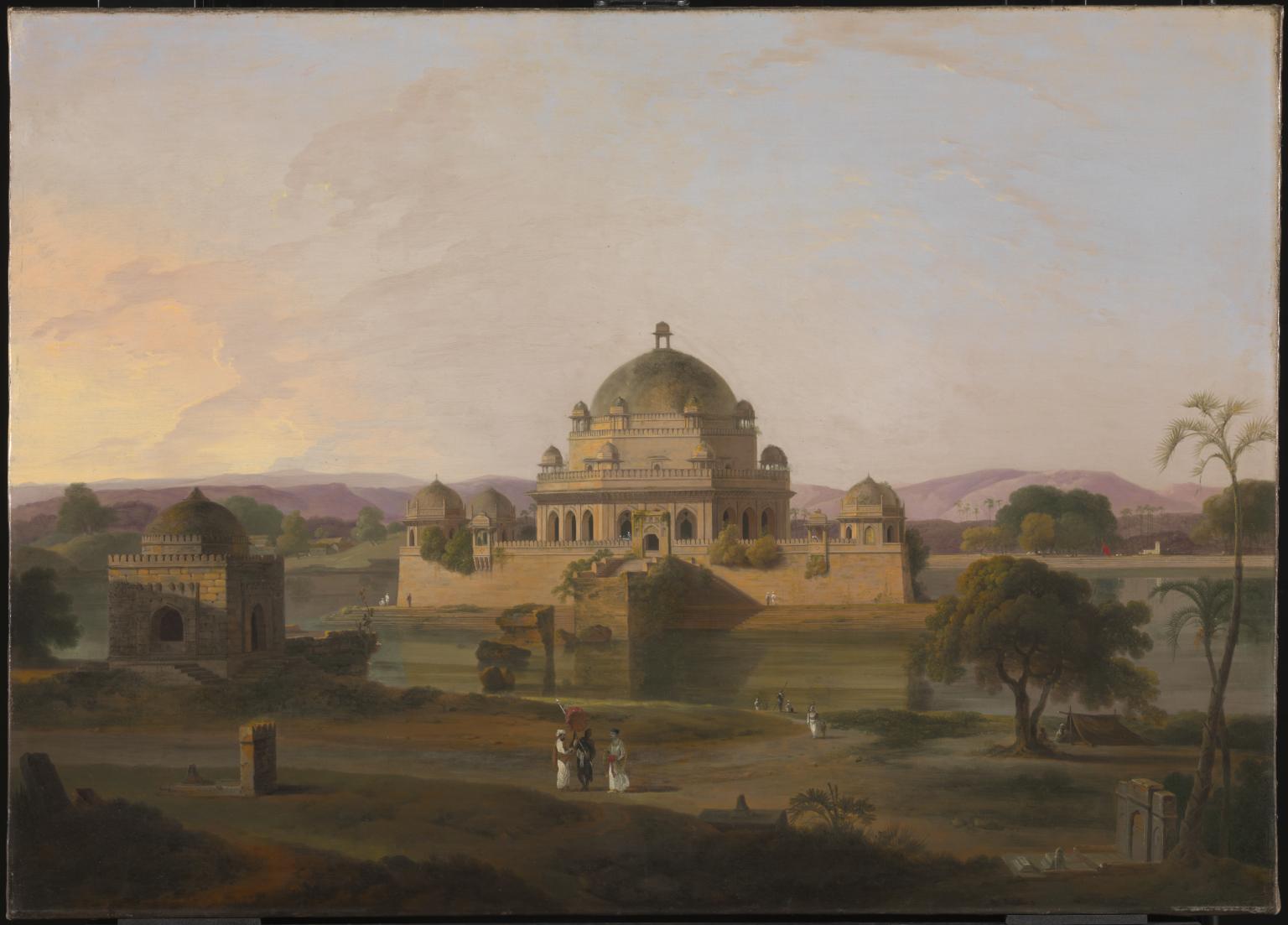
Thomas Daniell, Sher Shah’s Mausoleum, Sasaram 1810
This painting shows the monumental mausoleum of Sher Shah Suri (ruler of northern India from 1540–45) in Sasaram, a city in north-eastern India. Thomas Daniell and his nephew, William, visited Sasaram in February 1790 while undertaking an extensive tour to sketch sites across northern India. Daniell made this painting after his return to England, exhibiting it at the Royal Academy in London in 1810. Such images of India were popular with British audiences, offering a kind of armchair tourism. Daniell’s art helped shape British perceptions of Indian scenery and architecture.
Gallery label, August 2024
19/30
artworks in The Exhibition Age
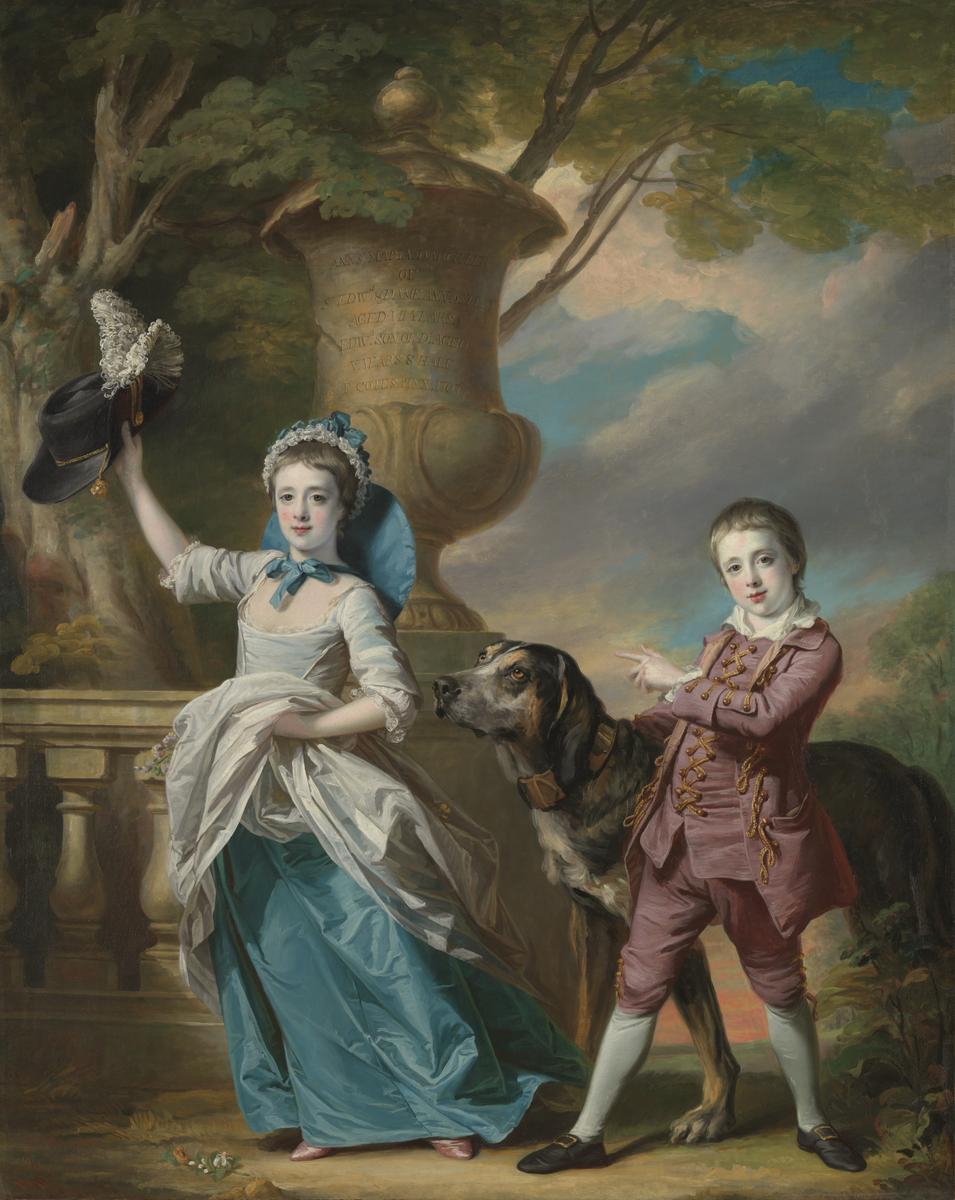
Francis Cotes, Anna Maria Astley, Aged Seven, and her Brother Edward, Aged Five and a Half 1767
The children in this portrait were the offspring of wealthy baronet and landowner Sir Edward Astley and his second wife Anne Milles. They are depicted at play on a classical terrace, reminiscent of the family’s grand estate at Melton Constable, Norfolk. Anna Maria, who waves her brother’s plumed hat above her head, died in childhood, the year after this portrait was painted. Edward, whose elder half-brother was to inherit his father’s title, lived to carve out a successful career as a soldier in the British army. It is thought that the portrait was commissioned by the children’s maternal grandfather.
Gallery label, February 2010
20/30
artworks in The Exhibition Age
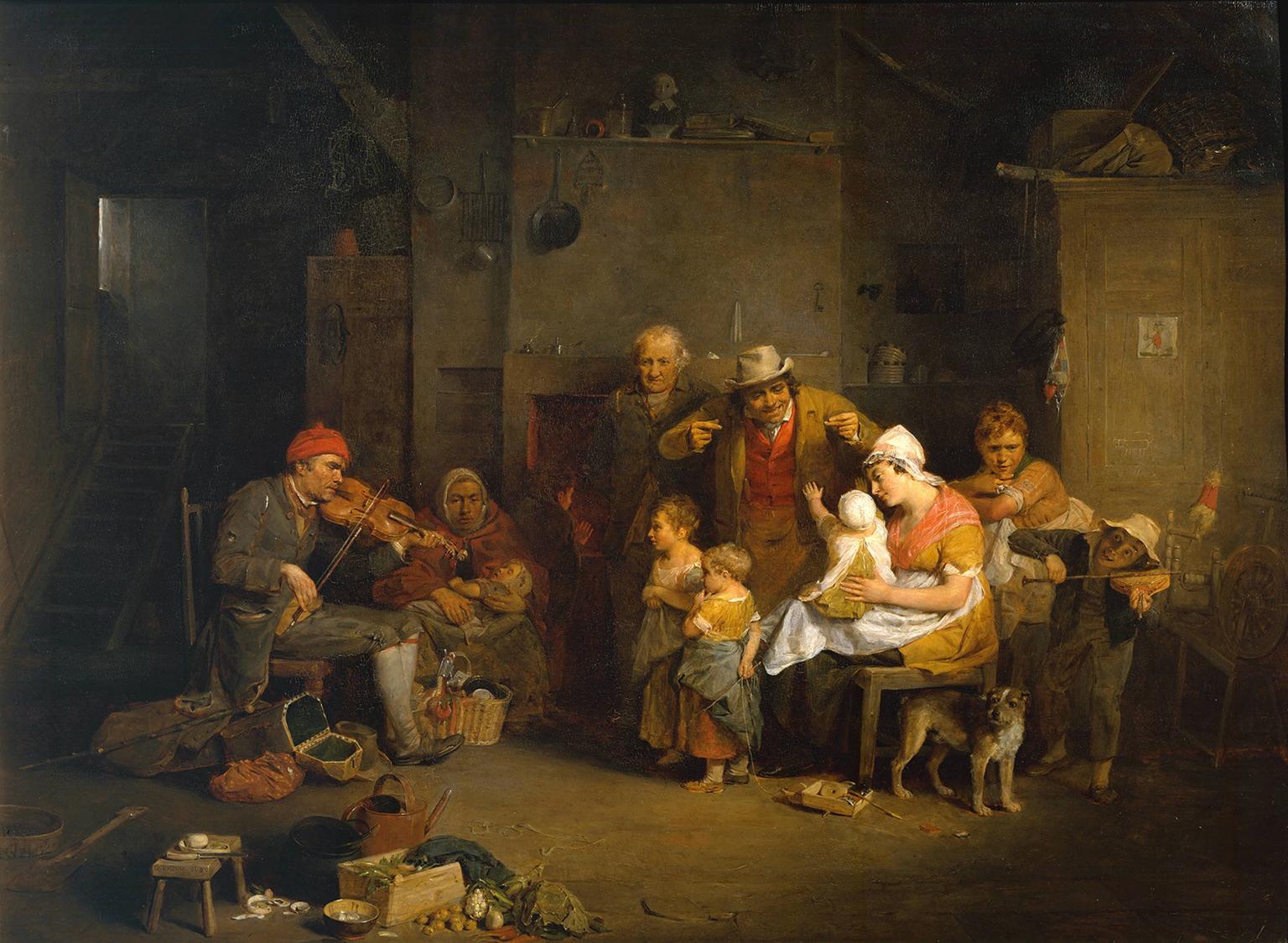
Sir David Wilkie, The Blind Fiddler 1806
David Wilkie suggests the emotional power of music here. He expresses the different reactions to the blind fiddler’s music – one young boy even pretends to play the fire bellows. This was only the second painting Wilkie exhibited publicly and it confirmed his reputation as a rising new star. A large crowd gathered around the picture when it was displayed at the Royal Academy. Exhibition-goers admired his observational skills, his characterisation, and his sympathetic view of everyday domestic life. It was hung next to JMW Turner’s A Country Blacksmith, which had a similarly subject and muted colours. Many contemporaries believed Turner was sparring with the younger artist.
Gallery label, February 2024
21/30
artworks in The Exhibition Age
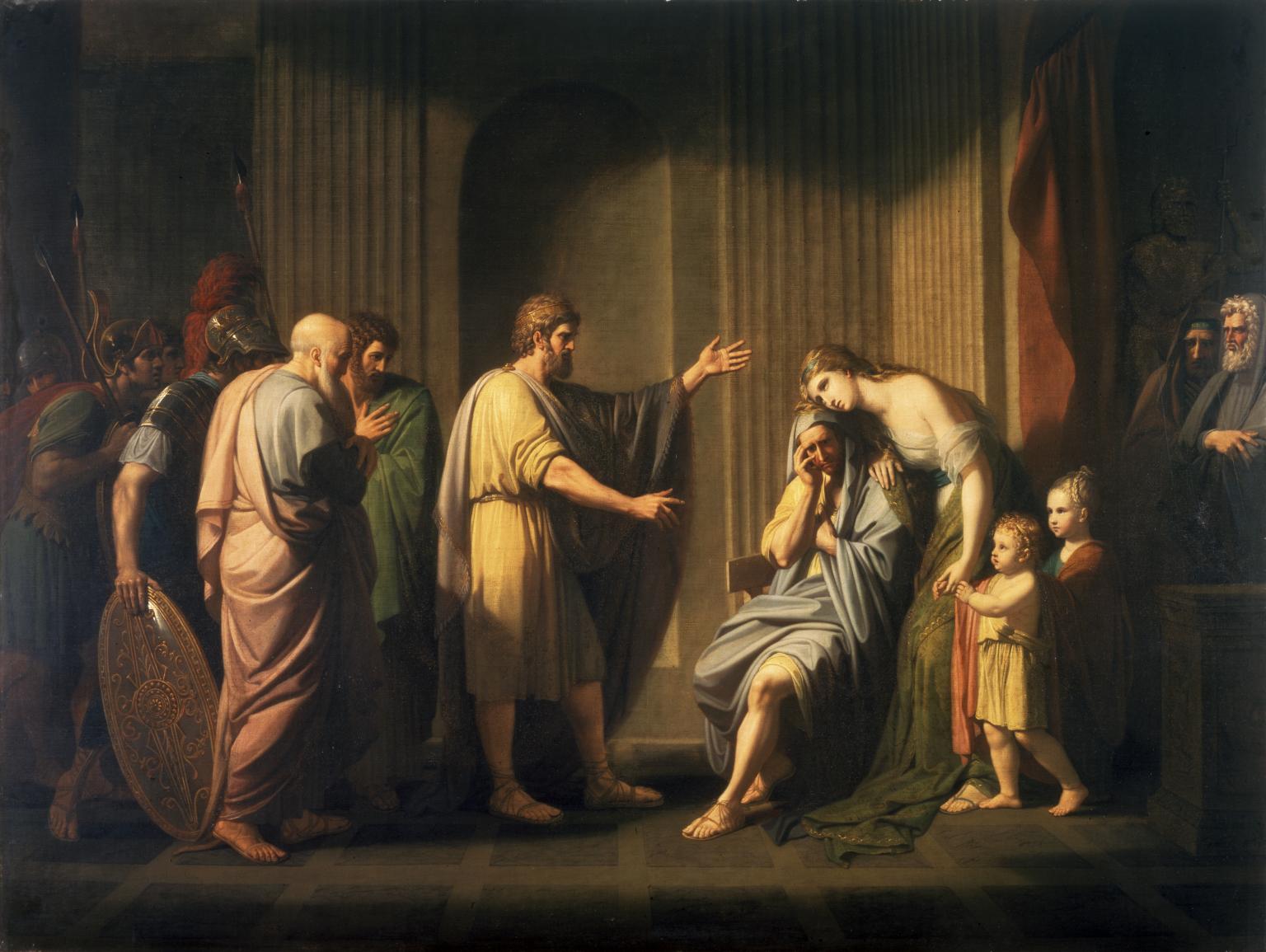
Benjamin West, Cleombrotus Ordered into Banishment by Leonidas II, King of Sparta 1768
Benjamin West showed this painting at the second exhibition of the newly formed Royal Academy. After several years in Italy, West had established himself in London as the leading painter of subjects from classical history. His example, and the Academy’s teaching, encouraged numerous young British artists to study in Italy.
His subject is an incident from ancient Greek history. Leonidas, king of Sparta, was usurped by his son-in-law, Cleombrutus. When Leonidas returns looking for revenge, his daughter pleads for her husband’s life. Leonidas is moved by her tears, and commutes Cleombrutus’s death sentence to banishment.
Gallery label, September 2004
22/30
artworks in The Exhibition Age
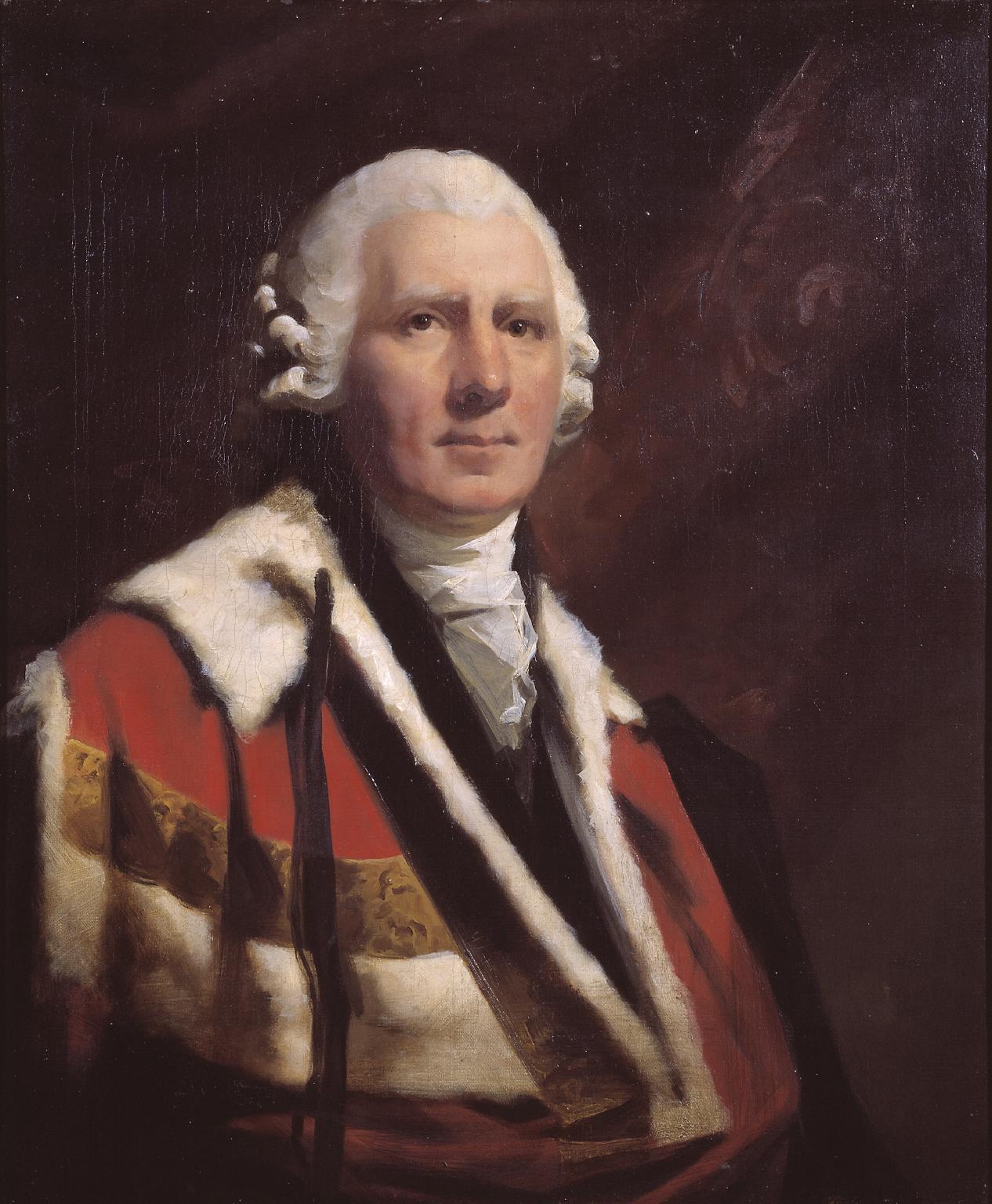
Sir Henry Raeburn, The 1st Viscount Melville c.1805
This portrait reveals Raeburn’s distinct style of painting – bold, energetic brushwork and use of strongly directed light. Raeburn enjoyed great success and painted many of the leading figures of Scottish society, including Henry Dundas, 1st Viscount Melville. Here, Dundas is shown looking confidently out, wearing formal robes. The portrait closely relates to an earlier commission of the sitter made for the Bank of England. Dundas was a powerful and controversial politician, known as ‘the uncrowned king of Scotland’. He was instrumental in British imperial expansion in India and supported ‘gradual abolition’, a stance that prolonged the abolition of slavery.
Gallery label, June 2026
23/30
artworks in The Exhibition Age

Gilbert Stuart, Portrait of a Man (Self-portrait?) c.1782–9
The American artist Gilbert Stuart probably painted this work in the 1780s, either in London or Dublin (where he moved in 1787). Stuart emerged as an independent artist in these years, becoming a rising star in the art world. This painting seems to reflect his growing confidence. It is painted with bold, emphatic brushstrokes and Stuart uses characteristically distinct, vibrant colours. The sitter himself, looks directly out at the viewer, his arms crossed. We don’t know the young man’s identity, although in the past it was thought to be a self-portrait.
Gallery label, February 2024
24/30
artworks in The Exhibition Age
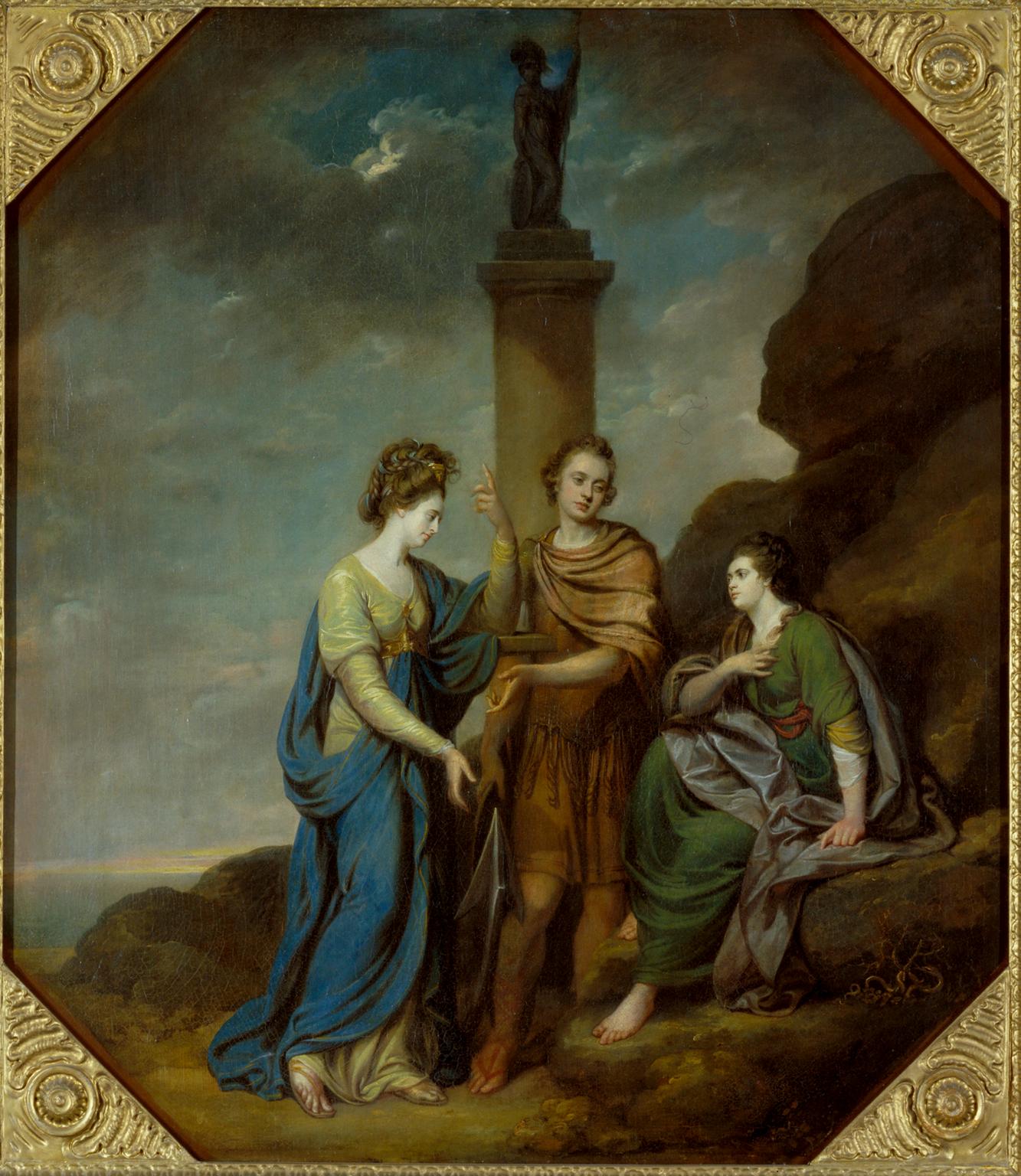
Richard Cosway, Portrait of a Gentleman, his Wife and Sister, in the Character of Fortitude introducing Hope as the Companion to Distress (‘The Witts Family Group’) 1770
Although principally a portrait miniaturist (see cabinet 2: The Portrait Miniature in the Eighteenth and Nineteenth Centuries), Richard Cosway also produced some larger-scale works in oil. This allegorical portrait was painted following the death of a young London linen draper, Broome Witts, in 1769. Witts is shown here in the role of Fortitude, introducing his sister Sarah in the guise of Hope (left) to his wife Elizabeth, depicted as Distress. This memorial image was presumably commissioned by one or both of these ladies.
Gallery label, August 2004
25/30
artworks in The Exhibition Age
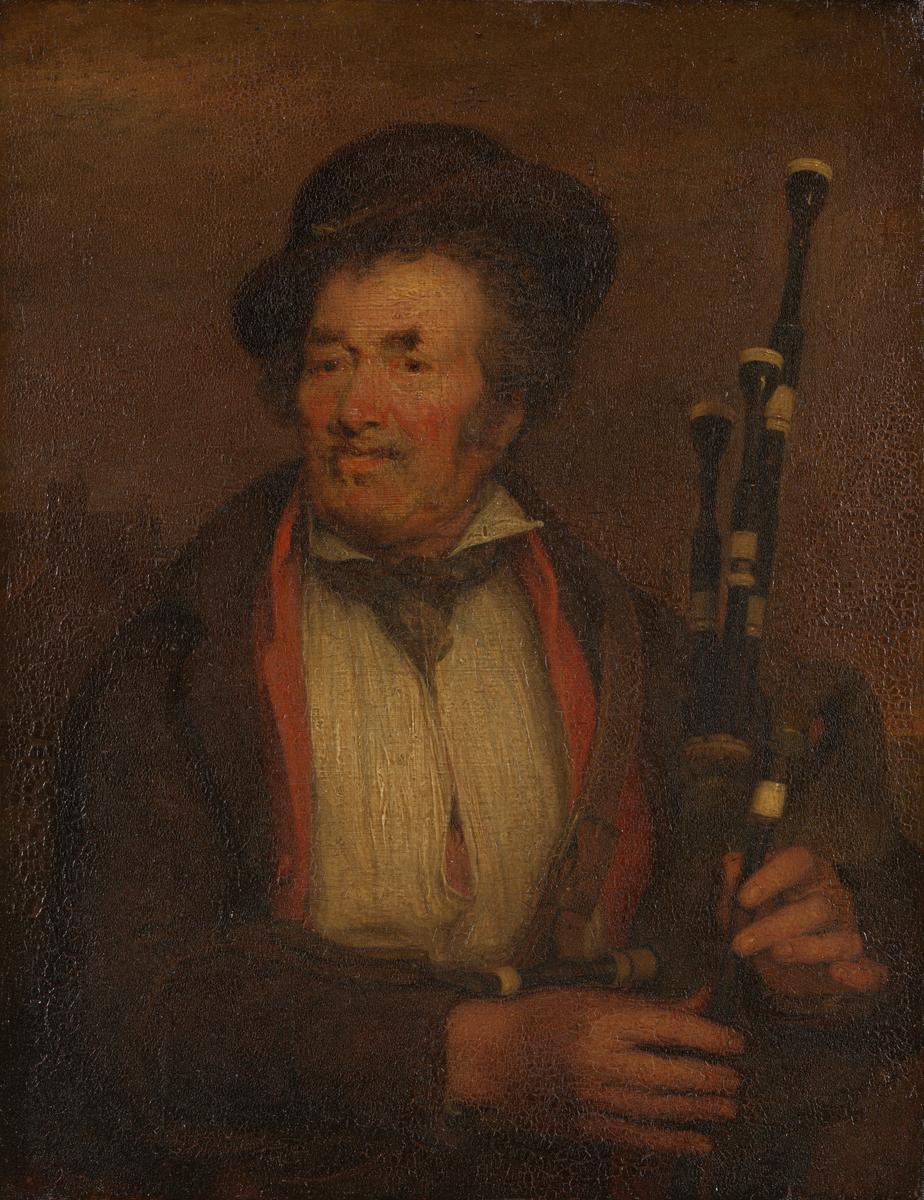
Sir David Wilkie, The Bag-Piper 1813, exhibited 1813
David Wilkie had already made his name in the London art world when he painted this small picture. It shows a bagpiper seemingly lost in thought, his fingers poised to play. One early biographer claimed this subject had been in Wilkie’s mind since boyhood and includes the old kirk (church) of his hometown, Cults, in the distance. While this is debatable, the explicitly Scottish subject is unusual in Wilkie’s work at this time. He exhibited this painting at the British Institution in 1813. While this may reflect his hope to raise the status of Scottish art, The Bag-Piper also appealed to a romanticised image of Scotland.
Gallery label, February 2024
26/30
artworks in The Exhibition Age
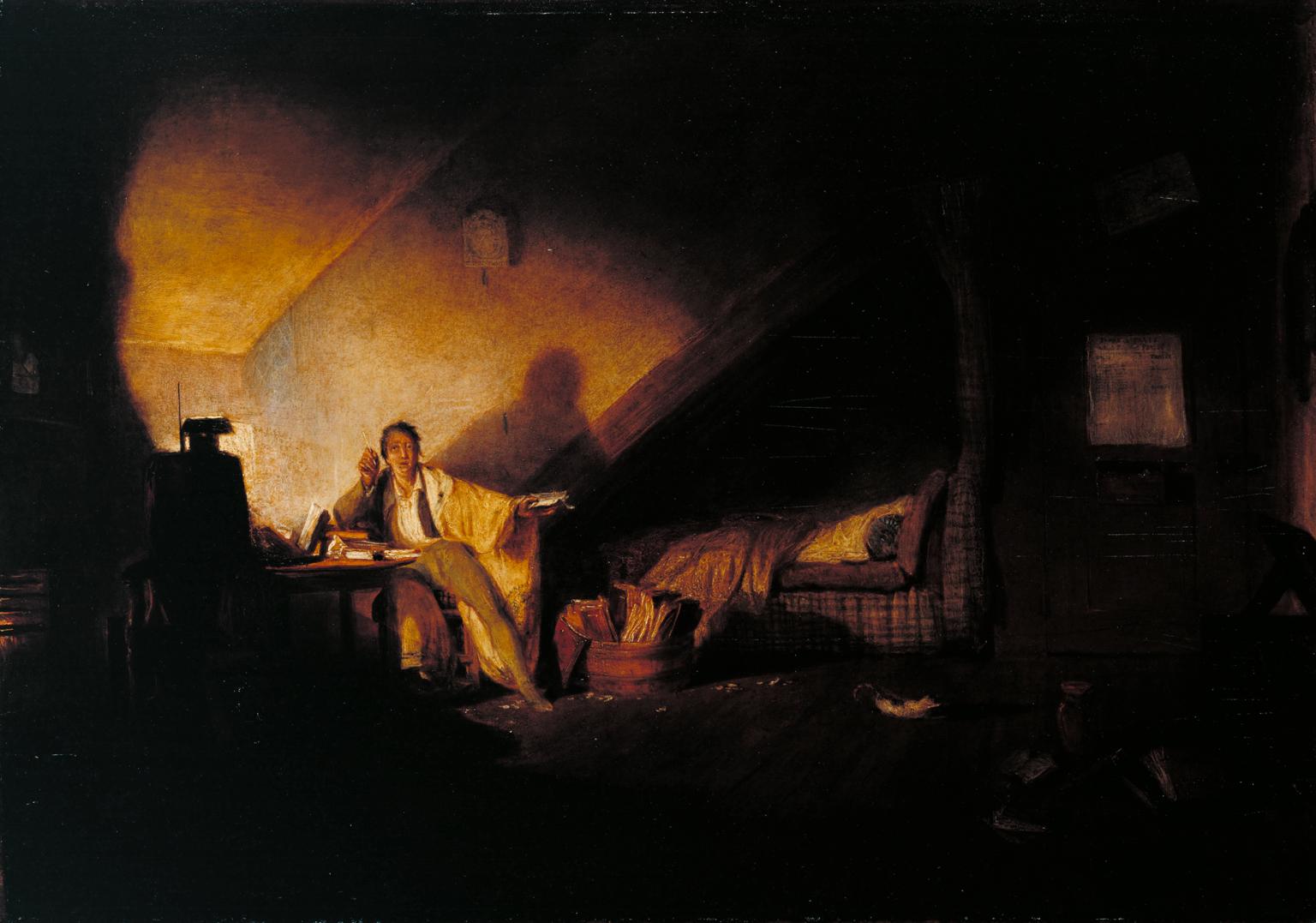
Joseph Mallord William Turner, The Garreteer’s Petition exhibited 1809
The scene shows a young poet struggling for inspiration late at night in his garret, a cramped attic room. On the wall is an image of Mount Parnassus, the mythological home of the Greek Muses, indicating his high ambitions. Though the point of the image seems to be satirical, the picture was exhibited at a time when Turner was writing poetry himself so likely sympathised with the poet’s predicament. Turner rarely painted explicitly figurative works but may have been inspired to do so due to his rivalry with David Wilkie whose genre subjects were extremely popular in London’s exhibitions.
Gallery label, February 2024
27/30
artworks in The Exhibition Age

John Opie, Portrait of a Lady in the Character of Cressida exhibited 1800
We do not know the identity of this woman, but she is probably a celebrity or actress who contemporary viewers would have recognised. Opie was working at a time when fame was becoming an increasingly important part of artistic success. This painting appeared at the Royal Academy’s annual exhibition in 1800. Artists jostled to grab public attention, painting more flamboyant and dramatic pictures. Opie depicts his sitter as the heroine of Shakespeare’s tragedy Troilus and Cressida.
Gallery label, October 2019
28/30
artworks in The Exhibition Age
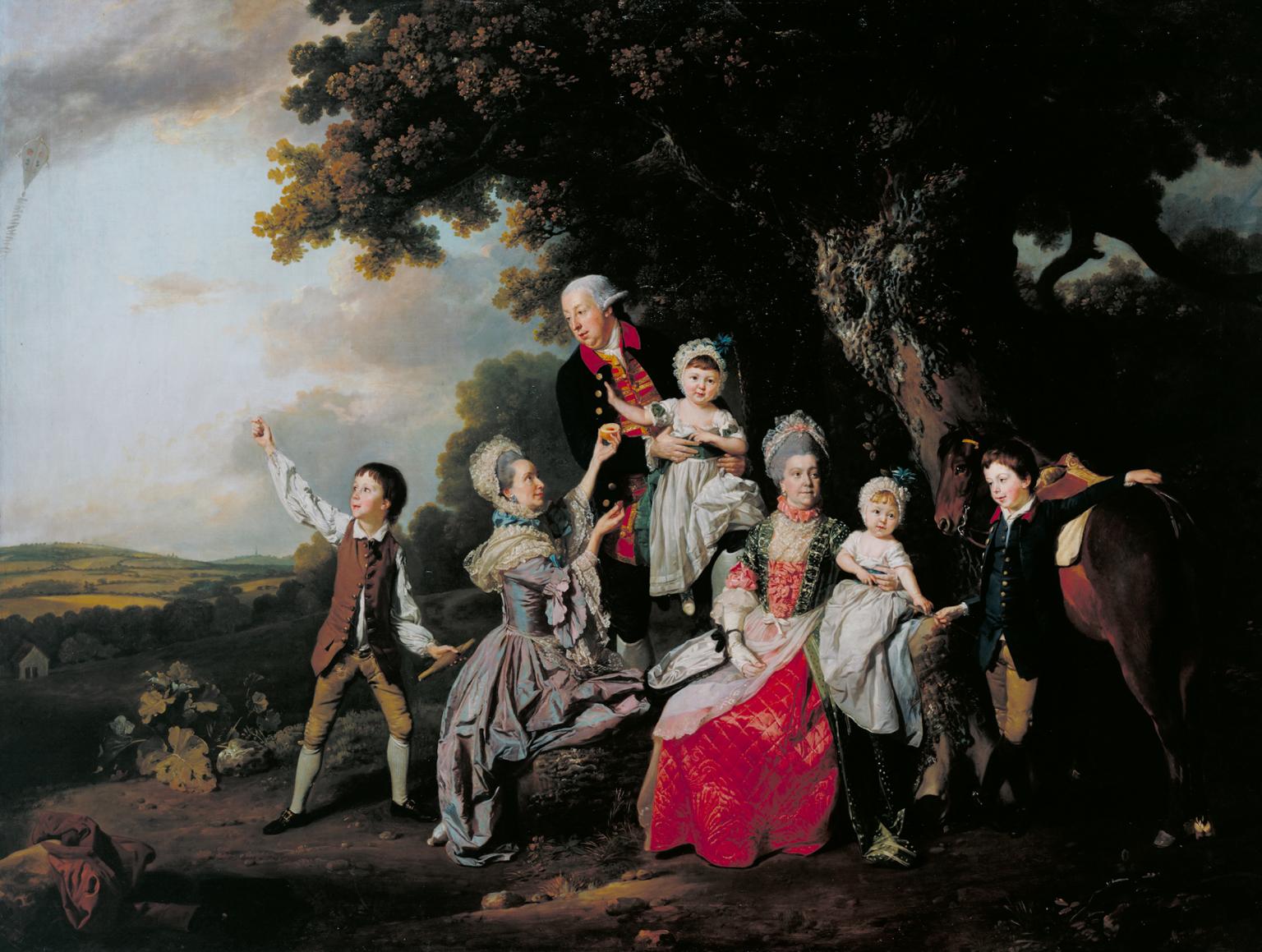
Johan Zoffany, The Bradshaw Family exhibited 1769
Small-scale group portraits like this, known as ‘conversation pieces’, projected an idealised vision of family life. This picture employs a pyramidal arrangement of the figures to express the structure of the family. Thomas Bradshaw (1733–74), a senior civil servant and politician, is shown at the apex of the pyramid. His family is arranged below him. The two women are Bradshaw’s wife, Elizabeth on the right, and, on the left, probably his sister. The two oldest sons are shown at the far left and right of the group. Their position in the composition serves to associate them both with the sheltered space of the family unit, and the outside world.
Gallery label, February 2016
29/30
artworks in The Exhibition Age
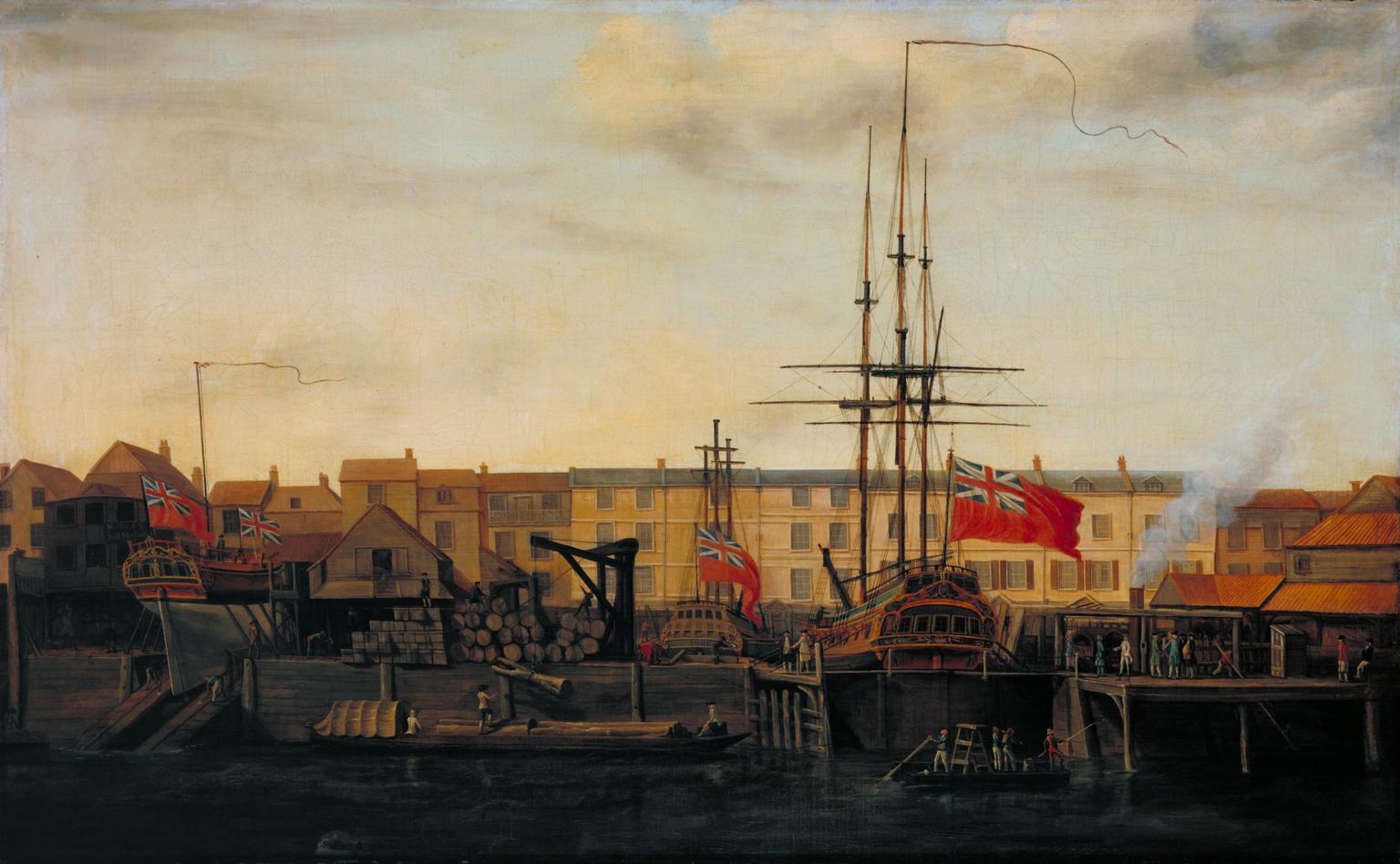
Francis Holman, A Dockyard at Wapping c.1780–4
Little is known about the artist Francis Holman. He was a painter of seascapes, ship's portraits and dockyard scenes, such as this small private dockyard on the Thames at Wapping. It is recorded that at one time Holman lived at Wapping, so he would have been intimate with the area and well able to execute this topographically accurate scene. He depicts with care the busy action of the dock, with ships in dry dock, and men unloading cargo. Even the sailmaker's firm of Morley, which is inscribed on the sign on the building to the extreme left, is known to have existed, directories listing it in Wapping until 1784.
Gallery label, August 2004
30/30
artworks in The Exhibition Age
Art in this room
Sir Thomas Lawrence
Homer Reciting his Poems
1790
John Hamilton Mortimer
Sir Arthegal, the Knight of Justice, with Talus, the Iron Man (from Spenser’s ‘Faerie Queene’)
exhibited 1778
James Northcote
A Young Lady Playing the Harp
?exhibited 1814
Richard Wilson
On Hounslow Heath
?exhibited 1770
Sawrey Gilpin, George Barret Senior
Broodmares and Colts in a Landscape
?exhibited 1783
John Hill
Interior of the Carpenter’s Shop at Forty Hill, Enfield
?exhibited 1813
You've viewed 6/30 artworks
You've viewed 30/30 artworks